We may earn a commission when you buy through links on this page, at no extra cost to you. How this works.
Choosing the right solar generator for your refrigerator means matching three essential numbers: the surge wattage your fridge draws when the compressor starts, the continuous running wattage it needs while operating, and the number of hours you want to keep it powered during an outage or off-grid use. Whether you're setting up backup power at home, running an RV fridge on the road, or living off-grid, underestimating any of these values can leave your food thawing or your battery drained mid-cycle.
This guide walks through the step-by-step formulas to calculate solar generator capacity specifically for refrigerators and freezers. You'll learn how to read nameplate data or measure actual draw, account for compressor surge loads, factor in duty cycles, and size battery capacity for your target runtime. We focus on the math and decision logic - this is not a comparison of inverter versus absorption refrigerators, and we do not cover solar panel array sizing or charge controller selection.
By the end, you'll have a clear watt-hour requirement and inverter rating to match against any solar generator spec sheet, ensuring your refrigerator stays cold without guesswork or over-buying capacity you don't need.
Who This Calculation Is For
This calculation applies to anyone planning to run a household refrigerator from a solar generator during a power outage, off-grid living situation, or in a mobile setup like an RV or cabin. It focuses on standard compressor-based refrigerators - the type most commonly found in homes - which cycle on and off throughout the day to maintain temperature.
If you're preparing for emergency backup, you need to know how long your solar generator can keep food safe when the grid goes down. Off-grid users need to match battery capacity to daily energy consumption and available solar recharge. RV and mobile setups require portability and efficiency, often with tighter space and weight constraints.
This guide does not cover 12-volt DC refrigerators designed for vehicles, or absorption refrigerators that run on propane or heat sources. Those systems draw power differently and require separate sizing logic. If your refrigerator plugs into a standard 120-volt outlet and uses a compressor, this calculation will help you choose the right solar generator size and avoid under- or over-buying capacity.
The Three Numbers You Must Measure First
Before you can size a solar generator, you need three specific measurements from your refrigerator: startup surge watts, continuous running watts, and duty cycle percentage. These numbers determine how much power capacity and battery reserve your system must provide to keep food cold without interruption.
Startup surge watts occur when the compressor motor turns on. This brief spike can be two to four times higher than the running wattage and lasts only a few seconds. Most inverters and solar generators must handle this surge or they will shut down. You can find an estimate by checking the refrigerator's nameplate label, usually inside the door or on the back panel, which lists starting amps or locked-rotor amps. Multiply starting amps by voltage (typically 120V in North America) to estimate surge watts. For a more accurate reading, use a plug-in power meter that captures peak wattage during compressor startup.
Continuous running watts represent the steady power draw when the compressor is actively cooling. This number is typically listed on the nameplate as running watts or running amps. If only amps are shown, multiply by 120V. A plug-in energy monitor will display real-time running wattage and is the most reliable method, especially for older units where nameplate data may not reflect actual consumption.
Duty cycle percentage tells you how often the compressor runs over a 24-hour period. Most refrigerators cycle on and off, running roughly 30 to 50 percent of the time depending on ambient temperature, door openings, and thermostat settings. To measure duty cycle, observe your refrigerator over several hours or use a power meter with logging features. Record total compressor-on time divided by total observation time, then multiply by 100 to get the percentage. This figure is critical for calculating daily energy consumption and battery capacity requirements.
If you do not have access to a power meter, manufacturer specifications or the Energy Guide label can provide estimated annual kilowatt-hours. Divide annual kWh by 365 to get daily consumption, then divide by 24 to approximate average hourly watts. Keep in mind this method smooths out surge and duty cycle details, so add a safety margin when sizing your generator. Accurate measurements from a plug-in meter give you the most confidence and prevent undersizing your solar generator.
Step 1: Calculate Minimum Inverter Capacity for Startup Surge
The first step in sizing a solar generator for your refrigerator is ensuring the inverter can handle the compressor's startup surge, which is the brief spike in power demand when the compressor kicks on. Most refrigerators draw 3 to 5 times their running wattage during startup, lasting only a fraction of a second, but your solar generator's inverter must be rated to supply this surge or the unit will shut down or fail to start the compressor.
Start by identifying your refrigerator's running wattage - typically between 100 and 800 watts for household models - and multiply by the surge factor, usually 3x to 5x. For example, if your refrigerator runs at 150 watts, assume a startup surge of 450 to 750 watts (150 × 3 to 150 × 5). Your solar generator's continuous inverter rating should exceed the running wattage, and the peak or surge rating must exceed the calculated startup surge. A generator with a 300-watt continuous rating and 600-watt surge rating would handle a 150-watt refrigerator with a 450-watt surge, but would fall short if the actual surge reaches 750 watts.
To find the exact surge factor for your model, check the nameplate on the back or inside the door, which may list "starting watts" or "locked rotor amps." If only amps are given, multiply amps by voltage (120V in North America) to estimate watts. If no surge figure is listed, use 5x running watts as a conservative estimate. Always size the inverter to the higher end of the surge range to avoid startup failures, especially in cold environments where compressor loads increase.
This formula ensures your solar generator's inverter can reliably start and run the refrigerator without tripping protection circuits or damaging the compressor due to insufficient surge capacity.
Step 2: Calculate Battery Capacity for Your Desired Runtime
Once you know your refrigerator's running wattage and duty cycle, you can calculate the battery capacity needed to keep it running during an outage or off-grid period. Battery capacity is measured in watt-hours (Wh), and the basic formula is: running watts × duty cycle percentage × desired runtime hours.
For example, if your refrigerator runs at 150 watts with a 40% duty cycle (0.40), and you want 24 hours of backup power, the calculation is: 150 W × 0.40 × 24 hours = 1,440 Wh. This is the raw energy your refrigerator will consume over that period.
However, two efficiency factors reduce the usable capacity of any solar generator. First, the inverter that converts DC battery power to AC power for your refrigerator typically operates at 85 - 90% efficiency, meaning 10 - 15% of stored energy is lost as heat. Second, lithium iron phosphate (LiFePO4) batteries should not be discharged below 20% to preserve cycle life, so only 80% of the rated capacity is safely usable. Lead-acid batteries are more restrictive, with a safe discharge depth of just 50%.
To account for these losses, divide your raw watt-hour requirement by the combined efficiency factor. For LiFePO4 batteries with 85% inverter efficiency: 1,440 Wh ÷ (0.85 × 0.80) = 1,440 ÷ 0.68 ≈ 2,118 Wh. Round up to the next available capacity tier when shopping for a solar generator - in this case, a 2,200 Wh or larger unit.
If you're using lead-acid chemistry, the math changes: 1,440 Wh ÷ (0.85 × 0.50) = 1,440 ÷ 0.425 ≈ 3,388 Wh, requiring a significantly larger battery bank. This is why LiFePO4-based solar generators are more popular for refrigerator backup - they deliver more usable capacity in a smaller, lighter package.
Always add a 10 - 20% buffer to your final number if you plan to run the refrigerator through multiple cloudy days or if you'll be powering other devices simultaneously. This buffer protects against unexpectedly long compressor cycles or voltage sag under combined loads.
Step 3: Add Safety Margin and Real-World Adjustments
Your calculated watt-hour requirement is a baseline, but real-world conditions demand headroom. Adding a safety margin of 20 - 30% accounts for factors that increase actual consumption: temperature swings that force the compressor to run longer, battery capacity degradation over time, frequent door openings during meal prep, and the power draw of other devices you may run simultaneously - like LED lights, phone chargers, or a small fan.
To apply the buffer, multiply your runtime watt-hour total by 1.2 (for 20%) or 1.3 (for 30%). If your refrigerator needs 600 Wh to run overnight, a 20% margin brings the target to 720 Wh, while a 30% margin pushes it to 780 Wh. The larger buffer is safer in hot climates, where compressor duty cycles increase, or if the generator will also supply auxiliary loads.
Once you have the adjusted watt-hour figure, compare it against the usable capacity of solar generators in your budget. Remember that lithium battery systems typically deliver 80 - 90% of their rated capacity under load, so a 1000 Wh generator may provide 800 - 900 Wh in practice. Cross-check the continuous output wattage rating to confirm it exceeds your fridge's running watts, and verify the surge rating covers the startup spike. This two-step validation - capacity headroom and output power - ensures the unit won't shut down mid-cycle or drain prematurely, giving you reliable backup even when conditions aren't ideal.
Pre-Purchase Sizing Checklist
- Measured or confirmed startup surge watts for your refrigerator
- Measured continuous running watts during steady-state operation
- Estimated duty cycle percentage (measure over 24 hours if possible)
- Calculated minimum inverter continuous and surge capacity
- Calculated minimum battery watt-hours for desired runtime
- Added 20-30% safety margin to battery capacity
Common Sizing Mistakes to Avoid
Many buyers underestimate their solar generator needs by focusing on a single specification and overlooking the system's real-world behavior. The most common mistake is ignoring startup surge, which can be three to seven times the running wattage and will trip an undersized inverter immediately. Always confirm your inverter's peak or surge rating can handle your refrigerator's compressor kick.
Another frequent error is using nameplate wattage without adjusting for duty cycle. A 150 W refrigerator does not draw 150 W continuously; it cycles on and off based on temperature. If you calculate battery capacity using continuous draw, you will oversize your system and waste money. Instead, multiply running watts by the duty cycle percentage to estimate actual watt-hours per day.
Forgetting inverter efficiency loss leads to undersizing. Most inverters operate between 85% and 95% efficient, so you must divide your refrigerator's watt-hour demand by the inverter efficiency to determine true battery capacity needed. A 1,200 Wh load at 90% efficiency requires 1,333 Wh from the battery.
Undersizing for temperature extremes is common in seasonal climates. Hot ambient temperatures increase compressor runtime and reduce battery capacity simultaneously. If you plan to use your solar generator in summer heat or freezing conditions, add a 20 - 30% buffer to both inverter capacity and battery size.
Assuming 100% battery discharge is safe shortens battery lifespan dramatically. Lithium batteries should generally stay above 20% state of charge, and lead-acid above 50%. Always calculate usable capacity, not total capacity, when planning runtime.
Finally, neglecting to plan for simultaneous loads causes real-world failures. If you run lights, a phone charger, or a fan at the same time as the refrigerator, each device adds to the inverter load and battery drain. Sum all concurrent wattages and peak surges to ensure your solar generator can handle the combined demand without shutting down.
When to Consider Expansion Batteries
Expansion batteries make sense when a single solar generator's built-in capacity won't cover your needs for extended power outages lasting longer than 24 hours, when you plan to run multiple appliances simultaneously alongside your refrigerator, or when you want to future-proof your setup for growing energy demands. If your baseline calculation shows you need 3,000 Wh to run your refrigerator for 24 hours but you want three days of backup, you'll need to multiply that capacity by three, bringing your total system requirement to 9,000 Wh. Many modular solar generators allow you to add external battery packs that integrate with the main unit, effectively stacking capacity without buying a second complete system.
Before purchasing expansion batteries, verify compatibility with your specific solar generator model - not all units support external battery expansion, and those that do often have limits on how many packs can be connected. Check the manufacturer's specifications for maximum expandable capacity, connection method (usually a dedicated expansion port), and whether the solar input can recharge the expanded capacity in a reasonable timeframe. A 400 W solar input that worked well for a 2,000 Wh base unit may take multiple days to fully recharge a 10,000 Wh expanded system, which could leave you vulnerable during consecutive cloudy days.
Calculate your total system capacity by adding the generator's internal battery to all connected expansion batteries, then compare that sum against your extended runtime target. For example, a 2,048 Wh generator with two 2,048 Wh expansion batteries gives you 6,144 Wh total - enough to run a 150 W refrigerator (drawing 200 W average with cycling) for roughly 24 - 30 hours depending on efficiency losses. Expansion batteries are most cost-effective when you've already invested in a quality base unit and need incremental capacity increases rather than replacing the entire system with a larger model.
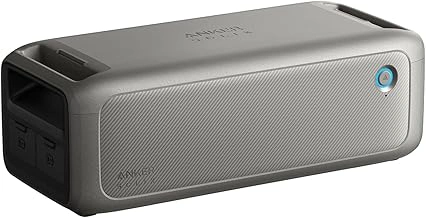
Anker SOLIX F3000 Expansion Battery, 3072Wh LiFePO4 with 10-Year Lifespan
When a single power station doesn't offer enough capacity to keep your refrigerator running through extended outages or off-grid periods, the Anker SOLIX F3000 Expansion Battery provides a modular way to add 3,multiple-hours of storage to a compatible base unit. This expansion battery uses LiFePO4 (lithium iron phosphate) chemistry, which is known for longer cycle life and thermal stability compared to standard lithium-ion cells, and carries a rated 10-year lifespan under typical use patterns.
Adding 3,072 Wh to your system means you can extend fridge runtime significantly without buying a second standalone generator. For example, if your refrigerator draws multiple on average, the expansion battery alone could theoretically supply roughly the listed amount of additional runtime (3,072 Wh ÷ multiple), though real-world efficiency and inverter losses will reduce that figure by ten to fifteen percent. Paired with a compatible Anker base station, this setup suits scenarios where you need multi-day backup or want to run a fridge alongside other loads without frequent recharging.
Because this is an expansion battery and not a standalone power station, it requires a compatible Anker SOLIX base unit to function - it does not include its own inverter or AC outlets. The modular design does offer flexibility: you can start with a smaller base station and scale capacity as your needs grow, rather than over-investing in a single large unit upfront. The LiFePO4 chemistry also means the battery should retain more usable capacity over thousands of charge cycles, making it a practical choice for regular seasonal use or long-term emergency preparedness.
At $1,199.99, the cost per watt-hour is competitive with other LiFePO4 expansion packs in this capacity range, and the 10-year lifespan rating suggests lower long-term replacement costs if you cycle the battery frequently. If your fridge backup plan includes overnight or multi-day runtime targets and you already own or plan to buy a compatible Anker base station, this expansion battery delivers straightforward, stackable capacity without the complexity of generator fuel or maintenance.
- ✅ 3,072 Wh capacity extends fridge runtime into multi-day scenarios
- ✅ LiFePO4 chemistry offers 10-year rated lifespan and thermal stability
- ✅ Modular design lets you scale capacity without buying a larger standalone unit
- ✅ Competitive cost per watt-hour for LiFePO4 expansion storage
- ⚠️ Requires a compatible Anker SOLIX base station - not a standalone power station
- ⚠️ No built-in inverter or AC outlets; capacity only
- ⚠️ Upfront cost may be high if you don't already own a compatible base unit
Protecting Your Refrigerator and Generator During Backup Power
Switching between grid power and a solar generator can expose your refrigerator to voltage fluctuations that may damage the compressor or control board. A voltage protection device sits between your generator and refrigerator, monitoring incoming power and disconnecting the load if voltage drops too low or spikes too high. Most models reconnect automatically after a programmable delay, which gives your compressor time to equalize pressure before restarting - a critical step that prevents motor overload and extends compressor life.
Time-delay reconnection typically ranges from 30 seconds to three minutes. This delay is especially important during outages when you switch from the grid to your solar generator, because the refrigerator may have been running moments before and the compressor needs time to depressurize. Without this delay, the compressor tries to start under load, drawing excessive surge current and risking thermal shutdown or reduced lifespan.
Look for a voltage protector rated for at least the continuous wattage of your refrigerator and verify that it can handle the surge current during compressor startup. Some units display real-time voltage, which helps you monitor your generator's output stability over time. If your solar generator lacks a pure sine wave inverter, a voltage protection device becomes even more important, as modified sine wave output can introduce harmonic distortion that stresses sensitive electronics.
Install the protector as close to the refrigerator as practical, and ensure the delay setting matches your compressor type - longer delays for larger or older units, shorter for modern inverter-driven compressors. This simple device adds a layer of insurance that protects both your food storage investment and your solar generator from avoidable wear.
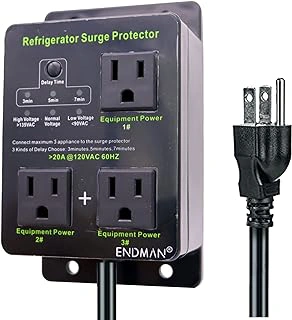
ENDMAN Refrigerator Surge Protector, 3 Outlet Voltage Protector with Time Delay
The ENDMAN Refrigerator Surge Protector provides inline voltage monitoring and time-delay protection when your refrigerator switches between solar generator and grid power sources. This 3-outlet voltage protector addresses a common scenario: if your solar generator shuts down or you manually transfer the fridge to wall power, the built-in delay helps reduce the chance of the compressor from restarting immediately, reducing stress on the motor.
The unit monitors incoming voltage and cuts power if levels fall outside safe operating ranges, then waits before reconnecting. This helps reduce the chance of the compressor from cycling rapidly during voltage fluctuations - a situation that can occur when your solar generator's battery runs low or inverter switches modes. The three outlets let you protect the refrigerator on one socket while using the remaining outlets for other appliances that share the same circuit.
Setup is straightforward: plug the protector into your power source, then plug your refrigerator into the protector. The device is rated 4.4 out of 5 stars and is priced at $28.99. Because it adds a layer of monitoring between your solar generator and fridge, it suits users who frequently toggle between backup solar power and grid power, or who run their fridge on a solar generator with variable battery capacity.
This protector does not increase your solar generator's capacity or solve undersizing issues, but it does guard the compressor during power transitions. If your refrigerator will remain on solar power continuously without switching sources, the time-delay feature offers less advantage than in hybrid setups.
- ✅ Three outlets for refrigerator and additional devices
- ✅ Built-in time delay protects compressor during power transitions
- ✅ Voltage monitoring disconnects power outside safe ranges
- ✅ Simple plug-in installation between power source and appliance
- ⚠️ Does not expand solar generator capacity or runtime
- ⚠️ Time-delay feature most useful in hybrid grid/solar setups, less critical for continuous solar use
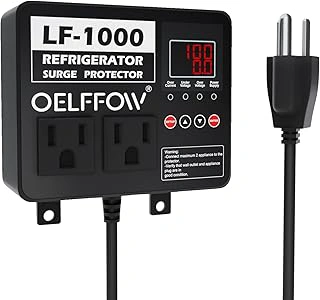
OELFFOW Refrigerator Surge Protector, 2 Outlet, Time Delay & Real-time Display
The OELFFOW Refrigerator Surge Protector offers two grounded outlets, a real-time voltage display, and a time-delay restart function in a compact form factor. Priced at $20.99, it provides essential surge protection and voltage monitoring for a single refrigerator or a refrigerator paired with one small appliance. The digital display shows incoming voltage in real time, letting you monitor power quality from your solar generator or grid connection without additional equipment.
The time-delay feature helps reduce the chance of the compressor from restarting immediately after a power interruption, which reduces inrush current stress on your solar generator's inverter. This is particularly useful during cloudy periods or when battery voltage dips momentarily. The two-outlet configuration fits behind most refrigerators without requiring a power strip, keeping your setup clean and minimizing points of failure.
With a 4.2 out of 5 rating, this model balances affordability and function for users who need voltage visibility and restart protection but don't require six or eight outlets. If you're powering only your refrigerator - or a refrigerator plus a small freezer - from a solar generator, the dual-outlet design reduces unused sockets and keeps the footprint small. The real-time display also serves as a quick diagnostic tool when troublesing solar generator output or inverter performance under load.
This surge protector works best in setups where outlet count is not a constraint and where you value immediate feedback on voltage stability. It does not include battery backup or sine-wave conditioning, so pair it with a pure sine wave inverter for optimal compressor protection.
- ✅ Real-time voltage display for monitoring solar generator output
- ✅ Time-delay restart reduces inrush current stress on inverters
- ✅ Compact two-outlet design fits behind appliances
- ✅ Budget-friendly at $20.99
- ⚠️ Only two outlets limit expansion
- ⚠️ No battery backup or sine wave conditioning included
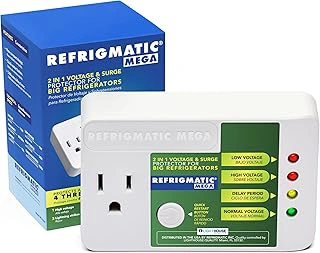
Refrigmatic MEGA 2-in-1 Electronic Voltage & Surge Protector for Refrigerators
The Refrigmatic MEGA 2-in-1 Electronic Voltage & Surge Protector offers dual protection for refrigerators running on solar generators, guarding against both voltage fluctuations and power surges that can occur during battery transitions or cloud cover. With a 4.6 out of 5 rating, this device has earned consistent user feedback for reliability in off-grid and backup power situations.
This protector plugs directly between your refrigerator and power source, monitoring incoming voltage and automatically disconnecting the appliance when levels fall outside safe operating ranges. The automatic reconnect function restores power once stable voltage returns, eliminating the need to manually reset the unit after brief solar dips or generator brownouts.
The 2-in-1 design handles both high-voltage spikes from unstable power sources and low-voltage conditions that can damage compressor motors over time. For solar generator users, this dual protection addresses the two most common power quality issues: surge events during startup or switchover, and voltage sag when battery capacity drops below optimal levels.
At $33.99, the Refrigmatic MEGA sits in the mid-range for refrigerator protection devices. The higher user rating and established market presence make it a sensible choice if you want proven performance backed by feedback from other users running refrigerators on alternative power systems.
Installing this protector adds one more component between your solar generator and refrigerator, but the tradeoff is automatic safeguarding without constant voltage monitoring. For setups where you can't watch power levels continuously - such as overnight runtime or remote installations - this hands-off protection can prevent compressor damage that would otherwise go unnoticed until failure occurs.
- ✅ 4.6/5 user rating reflects consistent positive feedback
- ✅ 2-in-1 protection handles both voltage fluctuations and surges
- ✅ Automatic disconnect and reconnect eliminates manual intervention
- ✅ Addresses common solar generator power quality issues
- ⚠️ Adds another component between generator and refrigerator
- ⚠️ Requires outlet space for inline installation
Final Takeaway
Sizing a solar generator for your refrigerator comes down to four connected steps: measure both surge and running wattage, calculate the total watt-hours needed for your desired runtime, add a safety margin to account for efficiency losses and variation, and verify that the generator's inverter and battery capacity meet those requirements. Each step depends on accurate input data - if your refrigerator's nameplate or manual provides the actual watts or amps, use those numbers rather than estimates. When the starting surge is high, confirm the inverter's peak rating can handle it for the few seconds required at startup. For runtime planning, remember that a refrigerator cycles on and off, so the actual draw over a full day is lower than continuous operation at running watts. If you need to power the refrigerator overnight or through extended grid outages, multiply the running watts by the total hours and divide by the duty cycle to estimate real-world watt-hour consumption. Adding a 20 - 25% safety margin protects against compressor wear, ambient temperature swings, and inverter efficiency that rarely reaches 100%. The result is a clear minimum battery capacity and inverter specification that keeps your refrigerator running reliably without risking damage to the generator or food spoilage.