We may earn a commission when you buy through links on this page, at no extra cost to you. How this works.
Home emergency backup requires reliable power that can start motor-driven appliances and sustain multiple circuits for days, not hours. A continuous 2000W inverter output draws the line between keeping a refrigerator, sump pump, and a few lights running versus watching food spoil and basements flood. Below that threshold, surge demands from compressor motors will trip the inverter or force you to choose between critical loads.
LiFePO4 chemistry matters because it tolerates deeper discharge cycles without degradation, operates safely across temperature swings, and delivers consistent voltage under load. Lead-acid and older lithium chemistries sag when you pull high current for extended periods, and they lose capacity faster when cycled daily during multi-day outages. LiFePO4 cells are rated for thousands of cycles at 80 percent depth of discharge, which translates to years of reliable standby service.
Surge capacity separates marketing specs from real-world performance. A 2000W continuous inverter typically handles 4000W peaks for a few seconds - enough to start a full-size refrigerator or a 1/3 HP sump pump. Units that publish only peak wattage without a continuous rating will disappoint when the compressor kicks in, and those using older chemistries will shut down mid-cycle as voltage drops.
This guide excludes power stations rated below 2000W continuous output, any unit using lithium-ion, lead-acid, or unspecified battery chemistry, and products with unverifiable runtime or expansion claims. The four models compared here publish continuous and surge specifications, use verified LiFePO4 cells, and support modular battery expansion to extend runtime beyond the base configuration. Each section links to manufacturer datasheets and includes only the capacity, inverter, and port specifications confirmed by the brand.
Use the matching tool first
Start with Blackout Readiness Load Planner if you want to narrow the fit before checking current offers.

Adapter DC7909 to DC8020
If you already own older Jackery solar panels with a DC7909 output connector but want to use them with a newer power station that accepts DC8020 input, this adapter provides the physical bridge. It enables legacy solar panel reuse without requiring a full panel upgrade, which matters when you're building capacity on a budget or simply want to extend the useful life of existing gear.
The adapter is a passive barrel connector that changes the plug size from the listed size × the listed size to the listed size × the listed size. It does not modify voltage, add power management, or provide any active electronics - polarity and voltage must already match between your panel and station. Compatibility is limited to specific Jackery panel and power station combinations, so confirm your exact models before ordering.
At $19.90, the adapter is priced as a convenience accessory rather than a critical component. It fits use cases where you're pairing older SolarSaga panels with compatible Explorer models, but it won't help with mismatched voltage rails or connector types from other brands. The 4.6/5 rating reflects straightforward plug-and-play function when used within the intended ecosystem.
This adapter is not a standalone power solution and does not belong in a primary backup system comparison. It's a fit-for-purpose bridge that keeps older solar hardware relevant when expanding or replacing a Jackery power station.
Check adapter compatibilityWhat to Look For in a Home Emergency Power Station
- Continuous output of 2000W minimum with documented surge capacity above 4000W
- LiFePO4 chemistry for 3000+ cycle lifespan and thermal stability
- Expansion capability via external battery packs or modular stacking
- Solar input rating of 800W or higher for daytime recharging during extended outages
- UPS mode or pass-through charging to protect sensitive electronics
- Verified outlet count: at least six AC outlets plus USB ports for simultaneous device support
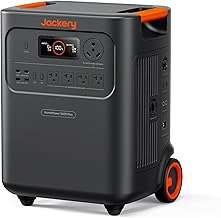
Jackery HomePower 3600 Plus Portable Power Station 3584Wh
The Jackery HomePower 3600 Plus delivers 3,584 Wh of LiFePO4 capacity in a single unit, putting it near the top of the capacity range for portable home backup stations. That baseline storage supports multi-day runtime for essential loads - refrigeration, internet, lighting, and medical devices - without requiring immediate expansion or recharging.
Jackery designed the HomePower 3600 Plus around modular expansion. The unit accepts additional battery packs that snap into the ecosystem, so you can start at 3,584 Wh and scale upward as your backup needs grow or as you add solar input during extended outages. This approach avoids the upfront cost of buying maximum capacity when a smaller reserve may cover most grid interruptions.
The inverter pushes 3,multiple continuous output, which handles simultaneous operation of a full-size refrigerator, a window air conditioner, and communication gear. Surge capacity accommodates inductive motor startup, though Jackery does not publish a specific peak-watt figure in the verified product details. If you plan to run well pumps or larger HVAC compressors, confirm compatibility with the manufacturer before relying on this station for those loads.
Solar input and pass-through charging let the unit harvest power while feeding connected devices, extending autonomy during daytime outages. The station includes multiple AC outlets, USB ports, and a multiple car socket, covering a range of plug types without needing separate adapters.
At $1,619.00, the HomePower 3600 Plus sits in the premium tier. The price reflects the high base capacity and the expansion platform, which reduces the need to replace the entire system if your power profile changes. Users who start small and later add batteries will pay incrementally, but the total cost of a fully expanded system will exceed budget models that ship with fixed capacity.
The 4.5 out of 5 rating suggests broad satisfaction, though user reviews often highlight weight and size as tradeoffs for the large internal battery. Portability becomes more notional once capacity exceeds large-capacity; plan to position the unit near your transfer panel or distribution point rather than moving it frequently.
Choose the Jackery HomePower 3600 Plus if you want a proven ecosystem that starts strong and grows with your needs, and you value the brand's track record in modular power solutions over absolute lowest cost per watt-hour.
- ✅ 3,584 Wh base capacity supports multi-day essential-load runtime
- ✅ Modular expansion platform scales capacity without replacing the core unit
- ✅ 3,000 W continuous inverter handles simultaneous high-draw appliances
- ✅ Solar input and pass-through charging extend autonomy during daytime outages
- ⚠️ Premium $1,619.00 price point higher than fixed-capacity competitors
- ⚠️ Weight and size reduce true portability at this capacity tier
- ⚠️ Surge wattage not specified in verified product details
How the Top 4 Power Stations Stack Up: Capacity, Output, and Expansion
Choosing the right LiFePO4 power station for home backup comes down to balancing capacity, inverter strength, and how far you can expand when a storm lasts longer than expected. The four models in this guide occupy different points on the spectrum, and understanding where each sits helps you match your actual needs to your budget.
At the entry level, the Anker SOLIX F2000 delivers 2,048Wh and a 2,400W continuous inverter at the lowest cost per kilowatt-hour in this lineup. Its 600W solar input and single-expansion path to 4,096Wh make it ideal for shorter outages and households that prioritize portability over multi-day autonomy. If you need power for a refrigerator, a few lights, and phone charging overnight, this capacity bracket works without requiring a second mortgage.
The Jackery Explorer 2000 Plus starts at 2,042.8Wh with a 3,000W inverter and scales to 12,000Wh with add-on battery packs. That 800W solar input ceiling and modular design suit users who want room to grow as their backup strategy matures. You pay more upfront, but the expansion headroom means you can start small and add capacity when budget allows, rather than replacing the entire system.
BLUETTI's AC200L offers 2,048Wh base capacity, a 2,400W inverter, and a documented 3,600W surge rating that handles well-pump and refrigerator compressor starts without tripping. Its 1,200W solar input is the fastest in this group, cutting recharge time during daylight hours. Expansion to 8,192Wh with B300 modules positions it between Anker's compact footprint and Jackery's maximum scale, making it a middle path for families who need reliable surge performance and moderate multi-day capacity.
The EcoFlow DELTA Pro starts at 3,600Wh - 76% larger than the smallest option here - with a 3,600W continuous inverter and expansion to 25,000Wh using additional batteries and the Smart Home Panel 2. Its dual 1,600W solar input means you can pull 3,200W total when using two charging streams, the highest rate available. This system is engineered for whole-home integration and extended outages, but the price per kilowatt-hour rises accordingly. If your backup plan includes running a sump pump, window AC unit, and all essentials simultaneously for days, this capacity and output combination justifies the cost.
Price per kilowatt-hour tells part of the story: Anker offers the most affordable entry, BLUETTI and Jackery sit in the mid-range with better expansion or surge specs, and EcoFlow commands a premium for its raw capacity and dual-input speed. Expansion ceilings matter when you face multi-day outages; a 4,096Wh limit may leave you rationing power on day three, while 12,000Wh or 25,000Wh configurations let you run normally until the grid returns. Solar input speed determines whether you can keep batteries topped off during cloudy weather or need to rely entirely on stored energy. Continuous inverter output and documented surge ratings decide which appliances start reliably and which remain dark.
No single model wins every category. Anker minimizes upfront cost but caps your ceiling early. Jackery balances modularity and mid-tier pricing. BLUETTI emphasizes fast solar recharge and proven surge handling. EcoFlow dominates capacity and whole-home integration at the highest price. Match your home's critical load, your typical outage duration, and your available roof or yard space for solar panels to the station that aligns with those realities, and you'll avoid both overpaying and under-preparing.
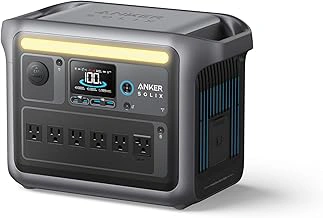
Anker SOLIX C1000 Portable Power Station 1056Wh
The Anker SOLIX C1000 delivers multiple of continuous power and 1056Wh of LiFePO4 capacity at the lowest entry price in this category. At $399.99, the price-per-watt-hour works out to roughly the listed amount, competitive with smaller units but offering meaningful inverter headroom for refrigerators, sump pumps, and other motor-start loads during outages.
The 1056Wh capacity handles overnight essentials - a full-size fridge drawing multiple will run approximately seven hours, or a combination of LED lighting, phone charging, and a laptop for extended periods. This is not a multi-day solution on its own. If your outage risk extends beyond multiple without solar input, you'll either need to ration loads carefully or plan for expansion.
LiFePO4 chemistry supports over 3,000 charge cycles to multiple% capacity, making this a durable long-term investment even at the smaller size. The multiple inverter gives you flexibility to power higher-draw appliances intermittently - a microwave, coffee maker, or space heater - without concern for inverter limits that plague many budget models.
The compact footprint fits kitchen counters and closet storage more easily than larger listed-capacity+ units, and the lower weight simplifies transport if you need to move the station between rooms or vehicles. For households prioritizing inverter capacity over extended runtime, or those planning to add solar panels later, this offers the most accessible starting point in the multiple LiFePO4 category.
The tradeoff is straightforward: you gain inverter capability and cycle longevity but sacrifice the multi-day autonomy of higher-capacity competitors. If your goal is to bridge short outages and keep critical loads online while minimizing upfront cost, the SOLIX C1000 balances those priorities without compromising on inverter performance or battery chemistry.
- ✅ Lowest cost per watt-hour in 2000W LiFePO4 category
- ✅ LiFePO4 chemistry rated for 3,000+ cycles
- ✅ Compact size and lighter weight for easier placement
- ✅ 2000W inverter handles motor-start and high-draw appliances
- ⚠️ 1056Wh capacity limits runtime to overnight essentials
- ⚠️ Not suitable for multi-day outages without solar expansion
- ⚠️ Smaller battery means more frequent recharge cycles under heavy use
Sizing Your System: Match Capacity to Your Critical Load
Matching your power station to actual household demand prevents both undersizing - which leaves you without power mid-outage - and costly overbuy. Start by listing critical appliances and their wattage: a typical refrigerator draws 150 watts continuously, totaling 3,600 watt-hours over 24 hours. An internet modem uses roughly 20 watts (480 Wh per day), while a CPAP machine averages 50 watts for eight hours (400 Wh). Sump pumps spike to 800 watts but cycle intermittently; assume four hours of actual runtime during heavy rain for 3,200 Wh.
A 1,000 Wh station covers a refrigerator and modem for about six hours, enough to bridge a short evening outage or keep medications cold overnight. For multi-day autonomy, budget 3,000 Wh minimum: that same refrigerator, modem, and CPAP together consume roughly 4,500 Wh daily, so a 3,000 Wh unit paired with 400 watts of solar input can stretch two to three days in good sun. If your list includes a well pump (another 800 watts intermittent) or window AC (1,200 watts), move to expandable 5,000 Wh or dual-battery configurations.
Solar pairing becomes worthwhile when your daily load exceeds half the station's rated capacity. A 2,000 Wh unit supporting 1,200 Wh per day will drain completely in under 40 hours without recharge; adding 300 - 400 watts of panels lets you recover 1,200 - 1,600 Wh on a sunny day, effectively doubling your usable window. In winter or cloudy regions, count on half that solar yield and size your battery reserve accordingly. Write down each appliance's wattage from its nameplate, multiply by expected hours of use, and total the watt-hours before choosing a model - this simple math ensures your investment matches your real-world need rather than guesswork.
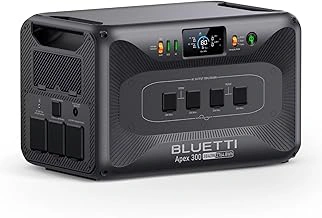
BLUETTI Apex 300 Portable Power Station 2764.8Wh
The BLUETTI Apex 300 begins with 2764.8Wh of usable capacity - roughly 30 percent more than the Jackery multiple Plus in base configuration - and ships with a modular battery architecture that lets you add expansion cells without replacing the core unit. If your daily emergency load runs multiple sustained (refrigerator, router, phone chargers, LED lighting), the stock 2764.8Wh delivers approximately eleven hours of runtime, giving you overnight coverage and margin for morning appliances before the grid returns or solar input takes over.
Each expansion battery slots into the unit's rear bay and connects via a keyed connector; BLUETTI publishes a maximum of four expansion packs for a total system capacity above multiple kWh, though that ceiling depends on the specific pack model you select. The base inverter remains multiple continuous output, so adding batteries extends runtime rather than increasing peak appliance support. Expansion packs typically retail between $1,multiple and $1,multiple each, putting the cost-per-kilowatt-hour below Jackery's when you scale past 8 kWh total capacity.
Solar pairing accepts up to multiple input across two MPPT controllers, so a six-panel multiple array can recharge the stock 2764.8Wh in under three hours of full sun - faster than the Jackery multiple Plus under identical panel wattage. The dual-controller design also helps reduce the chance of one shaded string from throttling the entire array, a practical advantage during winter months when roof shadows shift quickly.
The modular approach trades simplicity for flexibility: you store and transport each battery separately, and the system occupies more floor area than a single-chassis unit once you add three or four packs. If your backup plan calls for a week of autonomy or daily draw above 3 kWh, the Apex 300's expansion ceiling and per-kWh cost make it a stronger candidate than fixed-capacity alternatives. For households that need only two or three days of reserve and prefer a single-box solution, the added complexity may outweigh the capacity benefit.
- ✅ 2764.8Wh base capacity - 30% larger than comparable units in this price tier
- ✅ Modular battery expansion up to four packs for total capacity above 11 kWh
- ✅ Dual MPPT controllers accept 1200W solar input and prevent shading losses
- ✅ Lower cost-per-kWh than Jackery when scaling past 8 kWh total system size
- ⚠️ Expansion packs retail $1,200 - $1,700 each, requiring significant upfront budget for high-capacity builds
- ⚠️ Multiple battery modules occupy more floor space and complicate transport compared to single-chassis designs
- ⚠️ Base 2000W inverter does not increase with battery expansion, limiting simultaneous appliance loads
Real-World Runtime: What W Actually Powers
A 2000W inverter rating tells you the maximum simultaneous load the power station can handle, not how long it will run. Actual runtime depends on total capacity measured in watt-hours and the combined draw of every connected device. A refrigerator cycling at 150W average, a router at 20W, and two LED lamps at 10W each add up to 190W continuous - well below the 2000W ceiling but critical for calculating how many hours your station will last.
A 1000Wh unit powering that 190W load delivers roughly five hours of runtime before depletion, accounting for inverter efficiency loss of 10 - 15 percent. The same load on a 2000Wh station stretches to ten hours, and a 3500Wh model pushes past eighteen hours. These figures assume steady draw; refrigerators cycle on and off, so real-world performance often extends another hour or two. Add a 60W laptop and a 100W fan, and your total climbs to 350W, cutting those runtimes nearly in half.
Surge capacity matters during startup. A full-size refrigerator may pull 600 - 800W for two seconds when the compressor kicks in, even though it averages 150W during normal operation. If your inverter cannot handle that brief spike, the station shuts down to protect internal components. Most 2000W pure sine wave inverters tolerate 4000W surges for a few seconds, enough for typical household appliances. Confirm the surge rating in the product specifications before connecting motor-driven devices like sump pumps or window air conditioners.
Standby draw also reduces usable capacity. Keeping the inverter active while no load is connected consumes 10 - 25W per hour on many stations, draining a 1000Wh battery in two days if left idle. Switching off AC output between use preserves stored energy for the appliances you actually need. Battery management systems add another 5 - 10W of parasitic loss, invisible but measurable over extended outages.
Expansion batteries multiply runtime without changing inverter capacity. A base 2000Wh station paired with two 2000Wh expansion packs delivers 6000Wh total, tripling the hours you can power that same 190W load to thirty or more. The inverter remains 2000W, so simultaneous device count stays unchanged, but each appliance runs far longer. This approach scales better for multi-day outages than buying a second standalone unit, since one inverter and charge controller manage the entire bank.
Solar Pairing for Extended Outages: Input Limits and Recharge Reality
Solar panels extend runtime during multi-day outages, but recharge speed depends on three hard constraints: panel wattage, station input limits, and actual sunlight conditions. Most portable panels deliver 70 - 85% of their rated wattage in full sun, so an 800 W array feeding an 800 W-capable station will add roughly 600 - 700 W under ideal noon conditions. Cloud cover, panel angle, and morning or late-afternoon sun cut that figure further.
A 3,000 Wh station drawn to 20 percent needs about 2,400 Wh to reach full charge. At a sustained 600 W solar input, expect four to five hours of direct sun to complete the cycle. If your station's maximum solar input is 500 W, the same recharge stretches to five or six hours, assuming weather cooperates. Models with dual MPPT controllers and higher input ceilings - 1,000 W or more - shorten recharge windows but require larger, heavier panel arrays that are less practical to deploy quickly during an emergency.
Compare input limits across your shortlist. The Anker SOLIX F3800 accepts up to 2,400 W when combining solar and AC simultaneously, but solar-only input caps at 1,600 W. The EcoFlow DELTA Pro reaches 1,600 W solar input with the right cable configuration, while the Bluetti AC300 and Jackery Explorer 3000 Pro both handle 2,400 W and 1,400 W respectively when using manufacturer-matched panels. These numbers matter less on a single sunny afternoon and more during a three- or four-day outage when every hour of daylight counts.
Weather dependency is the hidden variable. Two overcast days can leave a station at 40 percent even with panels connected, forcing you to ration loads or run a generator to top off. Plan solar as a recharge aid, not a guarantee, and keep at least one backup charging path - vehicle DC or a small inverter generator - for stretch scenarios.
Making the Right Choice for Your Home's Needs
Choosing the right LiFePO4 power station starts with knowing your home's critical load and how long you need it to run during an outage. If your essential devices - refrigerator, router, lights, medical equipment - draw 500 - 800 watts combined, calculate total watt-hours by multiplying that load by the number of hours you want coverage. A 2048 Wh station will power 600 watts for roughly three hours, while a 4096 Wh unit doubles that runtime.
The Anker SOLIX F2000 works well for budget-conscious households with lighter backup needs and no immediate expansion plans. Its 2048 Wh capacity and 2400 W inverter handle short outages or rotating critical loads, but the lack of native expansion limits its role in multi-day scenarios.
The Jackery Solar Generator 2000 Plus balances upfront cost with proven expandability. You can start with 2042.8 Wh and add battery packs as your budget or risk profile grows, making it a practical middle ground for families who want room to scale without committing to a larger system from day one.
The BLUETTI AC300 + B300 offers the most headroom: modular design, the highest continuous and surge output in this comparison, and a clear path to 12,288 Wh. If you anticipate longer outages, higher simultaneous loads, or the need to power well pumps and HVAC blowers, this system provides the capacity and flexibility to match.
Remember that the RV-to-home adapter is an accessory for inlet-equipped homes, not a substitute for calculating your actual power requirements. Run the math on your critical circuits first, then choose the station that covers your watt-hour target with enough inverter capacity for your highest simultaneous draw.