We may earn a commission when you buy through links on this page, at no extra cost to you. How this works.
Running a solar generator 50, 75, or even 100 feet from your panel array introduces a power-delivery challenge most household extension cords can't handle. Voltage drop - the loss of electrical potential as current travels through resistance - scales with distance and shrinks with wire diameter. A thin 16 AWG cord that works fine for a desk lamp will waste watts and trigger low-voltage shutdowns when asked to carry 10 amps across a campsite or job site.
Wire gauge is the foundation. American Wire Gauge (AWG) numbers run inversely: lower numbers mean thicker copper and less resistance. For solar generator DC runs over 25 feet, 12 AWG is the practical floor; 10 AWG becomes necessary beyond 50 feet at higher current loads. Connector type is equally critical. MC4 terminals dominate modern solar panels, while Anderson Powerpole and proprietary barrel plugs appear on generator input ports. A mismatch means adapters, extra connection points, and more resistance.
This guide excludes standard household AC extension cords, which are built for different voltage and current profiles, along with ultra-thin charging cables under 14 AWG that cannot sustain the amperage required for efficient panel-to-battery energy transfer. We focus on four heavy-duty options chosen for their combination of low-AWG copper, weather-resistant jackets, secure locking connectors, and lengths suited to real-world off-grid and backup-power layouts. Each pick was evaluated on wire gauge specification, maximum safe current capacity, connector pairing, and measured voltage retention over distance to help you match cable to system without guesswork or wasted energy.
Use the matching tool first
Start with Balcony Solar Recharge Time Calculator if you want to narrow the fit before checking current offers.
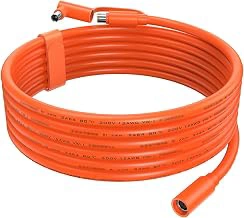
Tonton 30FT 9M 8mm 12AWG DC7909 to DC8020 Extension Cable for Solar Generators
When you need reliable power delivery over moderate distances without fighting thick, stiff cable, the Tonton 30FT 12AWG extension cable delivers the right balance of conductor size and handling ease. The 12AWG wire gauge keeps voltage drop minimal across a larger amount, making it well-suited for running solar panels to a generator station parked in shade or sheltered behind a vehicle.
The cable uses a DC7909 plug on one end and a DC8020 socket on the other, matching the input ports found on many portable solar generators. That connector pairing means you can extend the factory charging cable without hunting for adapters or risking a loose connection mid-charge. The 8mm cable jacket provides enough durability for outdoor use while staying flexible enough to coil without memory kinks.
At this price point, the Tonton cable offers a practical option for camping setups, tailgate power stations, or backyard solar arrays where you need an extra a larger amount of reach. The 12AWG conductor is thick enough to handle higher-wattage solar panels without sagging voltage, yet thin enough that you won't struggle wrestling it into position or packing it away. If your panels are consistently more than a larger amount from your generator, you may need to step up to a heavier gauge, but for most portable solar setups, this length and wire size hits the sweet spot between performance and convenience.
The build quality feels solid for the category - molded strain reliefs protect the solder joints at each connector, and the black PVC jacket resists UV and moisture better than bare copper would. Because the cable is a fixed 30-foot length, you avoid the weight and bulk of longer runs when you don't need them, and you skip the voltage penalties that come with daisy-chaining multiple shorter cables.
- ✅ 12AWG wire gauge minimizes voltage drop over 30 feet
- ✅ DC7909 to DC8020 connectors fit common solar generator inputs
- ✅ Flexible 8mm jacket coils easily without stiffness
- ✅ Molded strain reliefs at both connector ends
- ⚠️ Fixed 30-foot length may be too short for very distant panel placement
- ⚠️ No brand name on the jacket for field identification
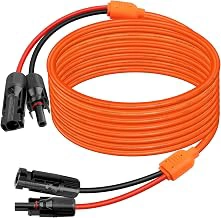
XRDS -RF 40FT 14AWG Tinned Copper Solar Extension Cable with Branch Wires
When solar panels must sit far from the generator - across a yard, near a better sun angle, or outside a shaded camping spot - the XRDS-RF 40-foot extension cable bridges the distance without splicing multiple shorter cords. The 40-foot length gives real placement flexibility, though the 14AWG wire is thinner than multipleAWG options and will show higher voltage drop over the full run, especially under heavy current draw.
Tinned copper conductors resist corrosion better than bare copper, making this cable a practical choice for coastal humidity, morning dew, or seasonal storage cycles. The tinned coating slows oxidation at connection points, which matters when terminals stay exposed to weather between uses. Branch wires let you connect two panels in parallel without hunting for separate Y-adapters, keeping the setup compact.
The tradeoff is straightforward: 14AWG carries less current efficiently than multipleAWG, so a multiple-watt panel array at a larger amount will lose more voltage here than through a shorter, thicker cord. For smaller panel setups - under multiple - or situations where you need every foot of that 40-foot reach, the gauge compromise remains manageable. Avoid pushing high-wattage arrays through the full length; voltage sag will cut charging speed noticeably.
Connectors are MC4-compatible, fitting most portable solar panels without adapters. The cable remains flexible in cool weather, coiling without kinking when you pack up. At this length, secure both ends and keep the cable path clear of sharp edges or foot traffic to prevent jacket abrasion over repeated deployments.
This cable earns its place when distance matters more than maximum current capacity. Pair it with modest panel wattage, inspect terminals for green corrosion every season, and you gain the reach needed for awkward generator placements without adding multiple connection points.
- ✅ 40-foot length extends placement options for distant panels
- ✅ Tinned copper resists corrosion in humid or coastal conditions
- ✅ Branch wires eliminate need for separate Y-adapters
- ✅ MC4-compatible connectors fit most portable solar panels
- ⚠️ 14AWG wire shows higher voltage drop than 12AWG over full 40-foot run
- ⚠️ Not ideal for high-wattage panel arrays above 200 watts at maximum length
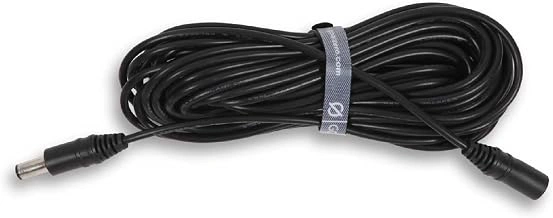
Goal Zero 30FT 9M 8mm Extension Cable for Solar Panels & Power Stations
Goal Zero owners who need extra cable length can rely on the 30FT 9M 8mm Extension Cable, engineered to match the connector standard used across the company's solar panels and portable power stations. This approach reduces the adapter uncertainty that often leads to connection failures when mixing third-party cables with proprietary plugs.
The 8mm barrel connector provides a snug fit on compatible Goal Zero units, locking in place without the wobble common to undersized generic alternatives. At a larger amount, the cable extends panel placement far enough to reach sunlight while the generator stays shaded, a practical balance between distance and voltage efficiency for most camp or tailgate setups.
Build quality reflects OEM attention: the cable jacket resists abrasion and UV exposure, and the molded strain reliefs at both ends reduce the flex damage that shortens the life of cheaper options. Users report a 4.7 out of 5 rating, noting stable power transfer and fewer dropout issues than mixed-brand combinations.
At $29.95, this cable costs less than some heavier-gauge universal options while delivering the reliability that comes from matched engineering. If your ecosystem centers on Goal Zero equipment and you value plug compatibility over universal flexibility, this extension removes the guesswork from cable selection.
- ✅ 8mm connector matches Goal Zero panels and power stations directly
- ✅ 4.7/5 user rating reflects reliable connection stability
- ✅ Molded strain reliefs and durable jacket reduce wear at flex points
- ✅ 30-foot length balances distance needs with voltage efficiency
- ✅ Lower price than many universal heavy-gauge alternatives
- ⚠️ Limited to Goal Zero ecosystem; requires adapters for other brands
- ⚠️ Not suitable for high-wattage arrays that demand thicker wire gauge
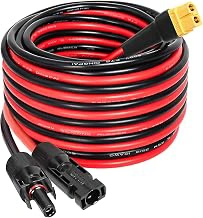
25FT 10AWG Solar to XT60 Extension Cable for Power Stations
The 25FT 10AWG Solar to XT60 Extension Cable delivers the thickest wire gauge in this lineup, making it the strongest choice when current capacity matters more than cable length. At a larger amount, it balances practical reach with maximum power throughput, using 10AWG copper to handle high-amperage loads without the thermal stress or voltage sag that thinner cables experience under heavy draw.
XT60 connectors lock firmly and resist accidental disconnection, a practical advantage when you're running power-hungry appliances from a portable station. The connector design also minimizes resistance at the junction, which helps preserve the voltage your equipment actually receives. For users pulling 10, multiple, or multiple continuously - think space heaters, microwaves, or power tools - this cable's conductor size keeps voltage drop below the threshold where devices begin to underperform or shut down.
The length-versus-gauge tradeoff is straightforward: you get less distance than multiple- or multiple-foot options, but the 10AWG wire moves more current with less heat buildup. If your solar panels or power station sit within a larger amount of your load and you need to maintain full wattage delivery, the thicker conductor pays off. The cable remains flexible enough to route around obstacles, though it's noticeably stiffer than multiple- or multiple-gauge alternatives.
Durability centers on the XT60 housing and the cable jacket. The connectors use nylon shells that resist UV exposure and impact, while the outer sheath protects the copper from moisture and abrasion. This cable won't replace a dedicated outdoor-rated marine cable in extreme conditions, but it handles typical RV, camping, and backup-power scenarios without degradation.
At $42.99, this cable sits in the budget tier while offering premium wire gauge. Users who need maximum current capacity over a moderate distance will find the price-per-amp advantage clear. If your setup requires longer runs or lighter loads, a thinner gauge at greater length may serve better, but for high-wattage applications within a larger amount, the 10AWG construction removes the guesswork around voltage drop and thermal limits.
- ✅ 10AWG wire gauge handles high amperage with minimal voltage drop
- ✅ XT60 connectors lock securely and reduce junction resistance
- ✅ 25-foot length balances reach and power throughput
- ✅ Budget-friendly at $42.99 for premium wire thickness
- ⚠️ Shorter reach than 50- or 100-foot options
- ⚠️ Stiffer cable due to thicker gauge
- ⚠️ XT60 connector may require adapters for some power stations
How Wire Gauge, Length, and Voltage Drop Interact in Solar Runs
Wire gauge determines how much electrical resistance your extension cord adds to a solar generator run. The AWG number works backward: a lower number means thicker copper wire, which carries more current with less voltage loss. A 10 AWG cord has roughly 40% more copper cross-section than 12 AWG, and 12 AWG has about 60% more than 14 AWG. That difference matters because resistance creates heat and wastes power, especially across long distances.
Voltage drop is the enemy of efficiency in solar applications. When you run a high-draw appliance - refrigerator, power tool, space heater - through a thin or long extension cord, the voltage at the far end can fall below what the device needs. Your solar generator may report full output, but the appliance receives less power and may shut off or run poorly. The drop follows a simple pattern: it doubles when you double the length or halve the wire thickness.
For heavy-duty solar generator use, follow these guidelines. A 10 AWG cord handles high continuous loads up to 25 - 30 feet without significant loss, making it the best choice for full-power runs to RVs, workshops, or backup circuits. A 12 AWG cord balances flexibility and capacity for 30 - 35 feet when your load stays under 15 amps continuous. Reserve 14 AWG only for runs beyond 40 feet where the connected load is light - LED lighting, phone chargers, laptop - or when you have no alternative and accept the efficiency penalty.
Household extension cords fail in solar setups because they prioritize cost and portability over sustained current capacity. Most indoor cords use 16 or 18 AWG wire, which overheats quickly under the continuous draw typical of solar generator applications. They also lack weather-resistant jackets and robust strain relief at the plug ends. A standard indoor 16 AWG cord at 50 feet can drop three to five volts under a 10-amp load, enough to starve sensitive electronics or trip low-voltage shutoffs. Heavy-duty solar cords use thicker wire, reinforced insulation, and molded plugs designed for outdoor duty cycles that last hours or days, not minutes.
Key Factors When Choosing a Solar Generator Extension Cord
- Wire gauge matches your power station's max input current (10 - 12 AWG for 100W+ panels)
- Connector type fits both your solar panel output and generator input without adapters
- Cable length covers your planned distance with at least 5 feet of slack for repositioning
- Tinned copper or UV-resistant jacket if the cable will be exposed to weather long-term
- Vendor provides AWG rating and current capacity specs - avoid vague heavy-duty claims
- Total system voltage drop stays under 3% when you add extension cord resistance to panel cable
Connector Compatibility: Matching DC Barrel, Anderson, and XT60 Plugs
Solar generators and panels use three primary connector families, and matching them correctly avoids voltage drop, heat buildup, and connection failures. The most common is the DC barrel plug, which comes in multiple sizes - 7.9×5.5 mm (often called 7909), 8.0×5.5 mm with a 2.0 mm center pin (8020), and 5.5×2.5 mm (5525). These barrel plugs typically handle 5 to 10 amps and appear on portable power stations up to 500 watts. If your generator uses a barrel input, measure the outer diameter, inner diameter, and center pin with calipers or check the manual before ordering a cable; a 7909 plug will not seat properly in an 8020 socket, and forcing it can damage the contact.
XT60 connectors dominate higher-current solar setups. The yellow nylon housing and gold-plated copper contacts are rated for 60 amps continuous, making them suitable for 12-volt systems pulling 30 to 40 amps or 24-volt arrays at lower current. XT60 plugs feature a beveled edge that enforces correct polarity - inserting them backward requires significant force and usually fails. You will find XT60 on mid-size generators from 1,000 to 2,000 watt-hours and on many folding solar panels rated above 100 watts. The connector's low resistance (less than 0.5 milliohms) keeps heat generation minimal even during peak charging.
Anderson Powerpole connectors offer a modular, genderless design used in emergency communication and off-grid power systems. The 15, 30, and 45-amp housings accept different contact sizes, and you can stack multiple connectors side by side for organized multi-circuit runs. Powerpole contacts slide into the housing and lock with a metal spring; proper assembly requires a specialized crimp tool to achieve gas-tight contact compression. Because the housings are genderless, polarity depends entirely on your wiring convention - the Amateur Radio Emergency Service standard places red on the left when the bevel faces you. A few portable power stations and charge controllers use Powerpole inputs, but the system is less common than barrel or XT60 in consumer solar generators.
Using an adapter to bridge connector types adds two more contact interfaces, each contributing resistance and a potential failure point. A barrel-to-XT60 adapter introduces roughly 10 to 20 milliohms of added resistance; at 10 amps that resistance dissipates one to two watts as heat and drops 0.1 to 0.2 volts. Stacking a second adapter - XT60 to Anderson, for example - doubles those losses. Whenever possible, select an extension cable with native connectors that match both your generator input and your panel output. If an adapter is unavoidable, choose one with gold-plated contacts, ensure the crimp or solder joint is sealed against moisture, and inspect it for heat discoloration after the first few charge cycles.
When to Use an Extension Cord Instead of Relocating Your Setup
Extension cords make sense when your solar generator and panels need to be in different places, but they aren't always the best solution. Before adding cable length, consider whether moving your equipment is simpler and more efficient.
Fixed panel installations create the clearest need for extension cords. Roof-mounted arrays or permanent ground mounts can't be repositioned to follow the sun or reach your generator. In these cases, running a heavy-duty cord between the fixed panels and a portable generator inside your home, shed, or garage becomes the practical choice. The same applies when your generator needs to stay indoors for security, weather protection, or noise containment while panels remain outside.
Shade avoidance is another common scenario. If your generator sits in the shade to keep internal components cooler or to comply with manufacturer temperature guidelines, you'll need a cord to connect it to panels placed in full sun. Large or awkward panel arrays - especially when multiple panels are wired together - can be too cumbersome to move frequently, making it easier to leave them stationary and run a cable to wherever you need power.
But extension cords introduce voltage drop, connector points that can fail, and extra cost. When your panels and generator are both portable and lightweight, moving the entire setup to eliminate cable runs often delivers better charging performance. If you're only stretching 10 or 15 feet, repositioning equipment usually beats adding an extension cord. Use cords when relocation isn't practical, not as a default accessory for every solar setup.
Matching the Right Cord to Your Power Station and Panel Wattage
Choosing the right extension cord starts with understanding your power station's input capacity and your panel's output. A 200-watt panel feeding a 500Wh station through a 30-foot run has very different needs than a 400-watt array pushing into a 2000Wh generator over 40 feet.
The Tonton 30-foot 12AWG cord works well for most balanced setups where you need moderate distance without excessive voltage loss. It handles everyday solar charging tasks for mid-range power stations and fits standard MC4 connectors found on portable panels. For situations where you must reach 40 feet - perhaps to keep your generator shaded while panels sit in full sun - the XRDS-RF 40-foot option trades a bit more resistance for the extra length, but remains a practical choice when placement flexibility matters more than minimizing every tenth of a volt.
Goal Zero's branded extension cord makes sense if you already own their ecosystem and want guaranteed connector compatibility, though you'll pay a premium for that brand alignment. When you're running high-wattage arrays over short distances, a 10AWG XT60 cord minimizes voltage drop more effectively than thinner 12AWG or 14AWG alternatives, even if the run is only 15 to 20 feet.
Wire gauge matters more than brand reputation. A quality 10AWG cord from an unfamiliar manufacturer will outperform a thin 14AWG cable from a recognized name when current flow is high. Always calculate total voltage drop across your entire charging path: your panel's built-in cable, the extension cord, and any adapters or connectors in between. A 3% loss in the extension cord might seem acceptable, but if your panel cable already accounts for 2%, you're approaching the threshold where charging efficiency noticeably degrades. Verify compatibility with your specific connector types before purchasing, and remember that longer runs require heavier gauge wire to maintain the same performance level.