We may earn a commission when you buy through links on this page, at no extra cost to you. How this works.
Most solar generators can push 1,000 to 3,600 watts through a single AC outlet, and that sustained draw creates heat in any wire it travels through. Standard household extension cords - those orange or beige 16 AWG and 18 AWG cables bundled at hardware-store checkouts - are rated for 10 or 13 amps at best, and they begin to overheat when you ask them to carry 15 amps continuously. When insulation softens or melts, you risk fire, breaker trips, and damage to the equipment drawing power.
Wire gauge matters because it determines current capacity. A 12 AWG cord can handle 15 amps over a longer run without dangerous voltage drop, while a 10 AWG cord scales to 20 amps or more. Continuous amperage rating tells you what the cord can carry hour after hour, not just for the thirty seconds it takes to start a table saw. Jacket type affects durability indoors: SJTW and SJEOW jackets resist abrasion and stay flexible in a wider temperature range than basic vinyl. Length adds resistance, so a 25-foot 12 AWG cord will deliver power more efficiently than a 100-foot run of the same gauge.
The four cords reviewed below meet minimum thresholds for safe indoor use with portable power stations: 12 AWG or heavier, continuous ratings that match common breaker limits, and jacket construction suited to living spaces rather than job sites. Each balances flexibility, plug design, and length to fit different room layouts and generator placements. If your solar generator will supply a refrigerator, space heater, or window air conditioner for hours at a time, using the right cord is not optional - it is the difference between reliable backup power and a melted plug.
Use the matching tool first
Start with Balcony Solar Recharge Time Calculator if you want to narrow the fit before checking current offers.
Understanding Key Specifications: Wire Gauge, Length, and Amperage Explained
Wire gauge determines how much current a cord can carry without overheating. The American Wire Gauge (AWG) system works backward: smaller numbers mean thicker wire and higher capacity. A 12 AWG cord has more copper than 14 AWG, which allows it to handle sustained loads above 1500 watts without excessive heat buildup. Most portable solar generators output between 1000 and 2400 watts, so matching gauge to your generator's capacity is the first safety checkpoint.
Length directly affects both voltage drop and heat. A 25-foot 12 AWG cord at 15 amps will drop approximately 3 volts, while a 50-foot run at the same load drops closer to 6 volts. That voltage loss reduces efficiency and forces the cord to dissipate more energy as heat. The National Electrical Code sets the threshold at 3 percent voltage drop for branch circuits, which translates to roughly 3.6 volts on a 120-volt line. For continuous loads, keep 12 AWG cords under 50 feet and 14 AWG under 25 feet when running high-wattage appliances.
Amperage ratings on extension cords reflect continuous use, not brief surge capacity. A cord marked 15 amps can theoretically carry that load indefinitely, but real-world safety margins matter. If your solar generator outputs 1800 watts at 120 volts, you draw 15 amps; a 12 AWG cord rated for 15 amps will run warm after an hour. Adding a margin - using 12 AWG for loads above 1500 watts and reserving 14 AWG for steady loads under 1500 watts - keeps insulation within safe temperature limits. Continuous operation means the cord never cools between cycles, so the insulation compound and jacket material must tolerate sustained heat without degrading.
To translate your generator's specifications into cord requirements, divide its continuous watt output by 120 volts. A 2000-watt-hour generator running at full output draws 16.7 amps, which exceeds the safe continuous rating of most 14 AWG consumer cords. Choose 12 AWG for any generator rated above 1500 watts, and verify the cord's amp rating matches or exceeds your calculated draw. For moderate loads - charging laptops, running LED lights, or powering a small refrigerator - 14 AWG works if the total load stays below 1500 watts and the cord length remains under 25 feet. These thresholds account for ambient temperature, coiled versus straight runs, and the cumulative heat from multiple devices plugged into a single cord.
Maximum safe length depends on both gauge and load. A 12 AWG cord can safely extend 100 feet at 10 amps, but only 50 feet at 15 amps. For 14 AWG, limit runs to 50 feet at 10 amps and 25 feet at 12 amps. Longer cords add resistance, which converts electrical energy into heat rather than useful work. If you need more reach, step up to a heavier gauge rather than daisy-chaining two lighter cords, which compounds resistance and creates additional failure points.
Use these baselines to evaluate any cord: check the gauge stamped on the jacket, confirm the amperage rating matches your expected load, and measure the run to ensure it falls within safe length limits for that gauge and current. These three variables - gauge, length, and amperage - work together to determine whether a cord will handle your solar generator's output safely over hours of continuous use.
Frequently Asked Questions About Generator Extension Cords
Can you use a regular household extension cord with a solar generator? No. Standard 16 AWG household cords cannot handle the sustained amperage draw from most portable power stations, especially when running appliances at or near rated capacity. Insufficient wire gauge causes overheating, insulation breakdown, and fire risk.
What happens if you use 16 AWG instead of 12 or 10 AWG? Voltage drop increases with distance and load. A 16 AWG cord carrying 15 amps over 50 feet can drop more than 10 volts, starving your appliances and generating dangerous heat inside the jacket. Over time, insulation melts and conductor strands oxidize, raising resistance further.
How do you calculate the right wire gauge for your load? Divide the wattage you plan to draw by your generator's output voltage to find the amperage. For example, 1,800 watts at 120 volts equals 15 amps. Match that current to the cord's continuous amperage rating at the length you need. If your run exceeds 50 feet or you expect near-continuous use, step down one gauge size for headroom.
Is SJTW or SOOW jacket better? SOOW rubber remains flexible in freezing temperatures, resists oil and abrasion, and tolerates rough outdoor conditions. SJTW thermoplastic is lighter, easier to coil, and adequate for indoor or protected outdoor use. For solar generator work indoors, SJTW offers better value; SOOW makes sense if the cord will also serve construction or jobsite duty.
Can you run a cord through a window? Yes, but pinching the jacket between sash and frame crushes the insulation and can sever conductors over time. Use a flat pass-through panel or grommet to protect the cable, and never close the window hard against the cord. If you route power indoors regularly, consider a permanent conduit entry or a sliding-door gap seal designed for cable pass-through.
Safety Checklist: How to Safely Run Power Indoors from Your Generator
- Confirm your solar generator's output wattage and match wire gauge accordingly (12 AWG for 1,500W+, 14 AWG for lighter loads).
- Measure the run distance and choose the shortest cord that reaches to minimize voltage drop.
- Inspect the cord jacket for cuts, abrasion, or exposed wire before each use.
- Avoid running cords under rugs, through doorways that close, or across high-traffic areas where they can be pinched or damaged.
- Use a single continuous cord rather than daisy-chaining multiple extension cords.
- Plug high-watt appliances directly into the cord, not through power strips or splitters.
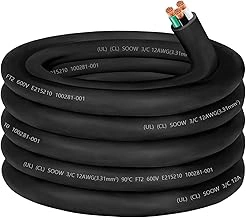
25ft 12/3 12 AWG SOOW Portable Power Cable
The 25ft 12/3 12 AWG SOOW Portable Power Cable handles high-watt solar generator loads without the voltage drop or heat buildup common in lighter-gauge cords. At 12 AWG wire and the listed size, this cable sits in the sweet spot for most garage-to-living-room or patio-to-kitchen runs, delivering multiple-amp continuous capacity with enough thickness to stay cool under sustained draw from refrigerators, power tools, or multiple devices plugged into a power station.
SOOW jacket construction separates this cord from the more common SJTW rubber you find on consumer extension cords. SOOW - an oil-resistant, hard-service thermoset rubber - tolerates abrasion, repeated flexing, and temperature swings better than lighter vinyl jackets. If you're running power across a garage floor, under a door threshold, or through a workshop where the cable might catch on equipment, SOOW holds up without cracking or exposing wire. SJTW cords work fine for lamp-duty indoor use, but under the continuous 1,multiple,high-wattage loads a solar generator can push, the thinner insulation and smaller copper strands generate more resistance heat.
Twenty-five feet minimizes voltage drop while covering typical indoor distances. Every foot of wire introduces resistance; at multiple or the listed size, even 12 AWG cable begins to waste watts as heat, and devices at the far end may see lower voltage. For a generator sitting in a garage powering a refrigerator ten feet inside the house, the listed size provides margin without adding unnecessary impedance. If you need to reach a second floor or an outbuilding, you'll need a longer run - but for the majority of indoor scenarios, shorter is safer and more efficient.
The tradeoff is reach. A longer cord offers flexibility for whole-home setups or distant appliances, but it also costs more, weighs more, and introduces higher resistance. If your solar generator lives in a central spot or you can position it near the point of use, the 25-foot length keeps the system simple and the cable manageable to coil and store.
At $35.99, this cable costs roughly double what a hardware-store 12-gauge extension cord runs, but the SOOW jacket and heavier-duty plug assemblies justify the premium. Cheaper cords may list 12 AWG on the label yet use thinner insulation or lower-grade terminals that heat up under continuous load. The 4.9/5 rating reflects durable construction and consistent performance in real-world solar generator applications. For most users running moderate to high loads indoors over short to medium distances, this 25-foot SOOW cable is the default pick.
- ✅ 12 AWG wire and 20-amp rating handle high-watt solar generator loads safely
- ✅ SOOW jacket resists abrasion, flexing, and temperature swings better than SJTW vinyl
- ✅ 25-foot length minimizes voltage drop for typical garage-to-room runs
- ✅ Heavy-duty plug assemblies and thick insulation reduce heat under sustained draw
- ⚠️ Higher price than hardware-store extension cords
- ⚠️ 25-foot reach may be too short for whole-home or distant appliance setups
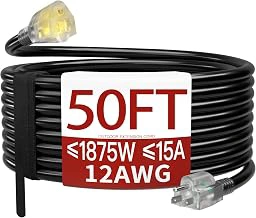
50 FT 12 AWG SJTW Heavy Duty Outdoor Extension Cord with Light
When you need to run solar generator power from a patio or garage to rooms deeper inside, the 50 FT 12 AWG SJTW Heavy Duty Outdoor Extension Cord with Light offers enough reach to bridge those longer distances without dropping down to a thinner, riskier wire gauge. The SJTW jacket provides water and abrasion resistance for runs that cross thresholds or sit on damp concrete, and the lighted plug indicator confirms a secure connection at a glance - useful when the outlet sits behind furniture or in a dim corner.
At the listed size, voltage drop becomes more noticeable than it is on shorter cords, so this 12-gauge line works best for continuous loads under multiple - enough for a refrigerator, space heater on medium, or a cluster of LED lights and phone chargers. If you plan to pull multiple or multiple continuously, the shorter longer multiple-gauge pick will handle that current with less voltage sag. For typical indoor appliances drawing multiple, this cord delivers stable power without heating up the jacket.
The tradeoff is straightforward: you gain the listed size of flexibility but accept slightly higher resistance and a lower safe continuous rating. Priced at $40.99 with a 4.8/5 rating, the cord costs more per foot than shorter alternatives, yet the combination of length, lighted feedback, and outdoor-rated insulation makes it practical for setups where the generator must stay outside and the load sits well into the house. If your longest run measures the listed size or less, save money and resistance by choosing a shorter cord; if you need every foot of that 50-foot span, this gauge and jacket design keep the connection safe and visible.
- ✅ 50-foot length bridges outdoor generator placement to interior rooms
- ✅ 12 AWG wire handles continuous loads under 15 amps over distance
- ✅ SJTW jacket rated for outdoor exposure and damp surfaces
- ✅ Lighted plug confirms secure connection in dim or hidden outlets
- ✅ 4.8/5 rating at $40.99
- ⚠️ Voltage drop over 50 feet limits safe continuous current to ~15 amps
- ⚠️ Higher cost per foot than shorter cords
- ⚠️ Not ideal for sustained 18 - 20 amp appliances without risking voltage sag
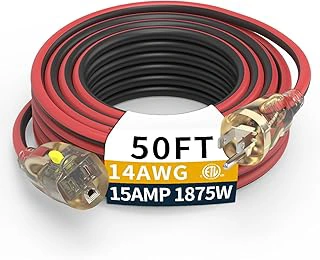
50FT Medium Duty 14/3 Outdoor Extension Cord with LED Lighted Locking Plug
When your solar generator stays under 1,multiple and you need the listed size of reach without spending top dollar, a 14-gauge outdoor extension cord can handle the job. The 50FT Medium Duty 14/3 Outdoor Extension Cord uses 14 AWG copper wire, which supports up to multiple at multiple - enough for laptops, LED lights, box fans, smaller refrigerators, and compact electric heaters rated under 1,multiple.
The LED lighted plug tells you at a glance that the connection is live, and the locking collar twists to secure the plug into the cord receptacle so vibration or accidental bumps won't disconnect your load mid-run. That feature matters when you're routing a cord across a hallway or behind furniture where someone might walk past.
At $39.99, this cord costs roughly half what many multiple-gauge options demand for the same length. The tradeoff is amperage headroom: 14 AWG will warm up faster under continuous load than thicker wire, so you should not pair it with space heaters above 1,multiple, window air conditioners, or power tools that draw multiple continuously for hours. For shorter backup sessions - charging devices overnight, running a small fridge during an outage, or powering LED work lights - the gauge is adequate and the price makes sense.
If your solar generator regularly outputs 1,multiple or more, or if you plan to run high-draw appliances back-to-back all day, budget an extra multiple for a multiple-gauge cord instead. The heavier wire will stay cooler and give you a wider safety margin. Use this 14-gauge model when your loads stay moderate, your generator's inverter tops out around 1,multiple, and you want a locking connection without paying premium-cord prices.
- ✅ LED indicator confirms live connection at a glance
- ✅ Locking collar prevents accidental disconnection
- ✅ Priced around half the cost of equivalent 12-gauge cords
- ✅ Handles up to 1,200 watts sustained for backup and lower-power appliances
- ⚠️ 14 AWG wire warms faster under continuous high load than 12-gauge options
- ⚠️ Not suitable for appliances drawing above 1,200 watts or tools that sustain 12 - 15 amps for extended periods
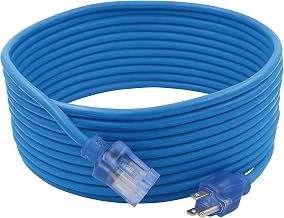
Clear Power 50 ft 14/3 SJTW -50°C Extreme Cold Weather Outdoor Extension Cord, Blue
Running a solar generator in an unheated garage during a winter outage, or routing power from an outdoor unit through a freezing entryway, demands an extension cord that stays flexible when the temperature drops. The Clear Power 50 ft 14/3 SJTW extension cord carries a -50°C jacket rating, meaning the outer insulation remains pliable in extreme cold instead of stiffening or cracking like standard PVC cords.
The SJTW designation indicates a weather-resistant thermoplastic jacket designed for outdoor use, and the blue color provides high visibility against snow or pavement. At the listed size, this cord gives enough reach to position a portable power station inside while the solar panels remain outdoors, or to bridge the distance from a generator on a porch to a window-mounted refrigerator during a winter storm. The 14 AWG conductor size handles up to multiple, suitable for moderate continuous loads such as a space heater on low, LED lighting, or a small freezer - but not for sustained high-wattage appliances like large electric heaters or power tools that demand multiple-gauge wire.
Standard extension cords lose flexibility below freezing, making them difficult to coil and prone to insulation damage when flexed. This cold-weather jacket remains manageable even when temperatures fall well below zero, a practical advantage when you need to reposition equipment or stow the cord quickly in harsh conditions. The three-conductor design includes a grounded plug, adding a layer of protection for sensitive electronics connected to your solar generator.
The trade-off is capacity: 14-gauge wire works for many common indoor loads, but pushing the full multiple-amp rating continuously over the listed size will generate more voltage drop and heat than a multiple-gauge alternative. For northern climates, unheated workshops, or any scenario where the cord will be exposed to sub-zero temperatures, the maintained flexibility justifies the gauge limitation. If your primary concern is cold-weather reliability rather than maximum power throughput, this cord fills a niche that standard indoor-outdoor extensions cannot.
- ✅ -50°C jacket rating keeps insulation flexible in extreme cold
- ✅ SJTW construction rated for outdoor and harsh-weather use
- ✅ 50-foot length suitable for outdoor-to-indoor solar generator runs
- ✅ High-visibility blue jacket for safety in snow or low light
- ✅ Grounded three-conductor design protects connected devices
- ⚠️ 14 AWG limits sustained high-watt appliance use
- ⚠️ Voltage drop more pronounced than 12-gauge over 50 feet
- ⚠️ Cold-weather jacket adds stiffness compared to indoor-only cords at room temperature