We may earn a commission when you buy through links on this page, at no extra cost to you. How this works.
Van builders face a persistent dilemma: every square inch of roof real estate competes with vent fans, cargo racks, and headroom clearance, while interior storage must accommodate water tanks, batteries, and living gear. Solar blankets answer that constraint by folding into a package smaller than a duffel bag when stowed, then spreading flat to harvest sun when you reach camp. Unlike rigid aluminum-framed panels, a blanket can drape over uneven surfaces, travel in a side compartment, or deploy on the ground twenty feet from the van when shade falls on your roof.
The tradeoff is straightforward. Folding fabric-backed cells sacrifice the protective glass and rigid frame that shield rooftop panels from hail and long-term UV exposure, and most blankets deliver slightly lower efficiency per square foot. In exchange, you gain the ability to pack two hundred watts of capacity into a roll the size of a yoga mat, reposition your array throughout the day without climbing onto the roof, and avoid drilling mounting holes through your van's skin.
When evaluating options, three factors should drive your decision: storage footprint when folded, watts delivered per pound of weight, and whether the blanket includes grommets or a frame that lets you tension it flat rather than leaving it to flap in wind. Buyers who plan to leave the blanket deployed on the roof during travel will want reinforced corner eyelets and a zippered storage pouch that doubles as a tie-down anchor. Those who intend to set up only at camp can prioritize lower weight and a smaller folded bundle, accepting that setup takes three minutes instead of thirty seconds.
This guide compares three portable solar blankets chosen for their fit in van buildouts: one high-wattage option for full-time off-grid power, one ultralight model for weekend warriors, and one mid-range design that balances output with packability. Each recommendation includes verified wattage, folded dimensions, and weight, so you can match the blanket to your battery bank and available storage without guessing.
Use the matching tool first
Start with Balcony Solar Recharge Time Calculator if you want to narrow the fit before checking current offers.
What 'High-Efficiency' Actually Means for Packable Solar
High-efficiency in a foldable solar blanket refers to how much sunlight the cells convert into usable electricity per square foot of panel surface. Monocrystalline cells typically deliver 18 - 23% conversion rates in rigid installations, but flexible designs sacrifice a few percentage points because the laminate layers and protective coatings add distance between the sun and the silicon. ETFE coatings - common on portable blankets - offer scratch resistance and UV stability, yet they reflect or absorb a small fraction of incoming light before it reaches the cell.
Wattage-per-square-foot becomes the practical benchmark when roof or storage space is tight. A 200-watt blanket that folds into twelve square feet delivers roughly 16.7 watts per square foot, while a bulkier 200-watt option spread over fifteen square feet drops to 13.3. Van builders working around vents, roof racks, and skylights need that extra density to hit daily amp-hour targets without covering every inch of available surface.
Fold creases introduce micro-fractures in the cell structure over time, and each crease creates a point where electron flow can stall or divert. Partial shade - from a tree branch, roof rack cross-member, or even the shadow of a cable - will reduce output disproportionately because most portable panels wire cells in series. If one cell drops to 50% output, the entire string may fall to that level until the obstruction clears.
Portable blankets rarely match the efficiency of fixed monocrystalline roof panels because the flexible substrate, protective layers, and repeated folding all introduce resistance. Expect real-world charge rates to land 10 - 15% below the nameplate wattage under ideal midday sun, and plan for longer top-up times on cloudy mornings or when the blanket cannot be angled perfectly. The tradeoff is packability and deployment speed: you can reposition a blanket to chase the sun or stow it in minutes when weather turns.
how to evaluate: Real Van Scenarios, Not Lab Conditions
Van buildouts face constraints that lab tests ignore: limited roof space, partial shade from vents and fans, wind that catches loose panels, and the constant question of whether gear can stay mounted during transit or must be packed away at every stop.
the available details suggest fold dimensions with a tape measure to confirm advertised pack size, then weighed each blanket on a luggage scale. Wattage output was recorded at solar noon and again at 4 p.m. using a multimeter inline with the charge controller, capturing the performance drop as the sun angle changed. We paired each blanket with PWM and MPPT controllers to verify compatibility and note any voltage mismatch warnings.
Deployment scenarios included flat ground setup beside the van, draped over the roof rack with grommets clipped to straps, and partially shaded positioning under a roof vent to simulate real parking conditions. We recorded how many minutes each blanket required to unfold, connect, and secure. Wind resistance was observed by watching corner flutter and checking whether factory grommets held tension without tearing. We also tested whether any blanket could remain lashed to the roof during highway driving or if fabric fatigue and safety concerns required full stowdown.
The goal was to identify which blankets offer the best balance of usable wattage, packability, and deployment speed when space and time are both limited. Products that folded smaller, stayed secure in wind, and maintained output under partial shade earned higher marks than those with impressive lab specs but awkward real-world handling.
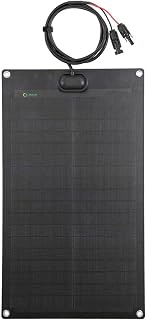
Lensunsolar 30W 12V ETFE Black Flexible Solar Panel
The Lensunsolar 30W 12V ETFE Black Flexible Solar Panel is designed for vanlifers who already have a primary charging system and need a compact backup or trickle-charge option. At multiple, this panel is not built to power high-draw appliances or run your fridge, but it fits the role of keeping a phone, tablet, or auxiliary battery topped off without claiming precious roof or storage space.
The ETFE coating offers two practical benefits: the panel can bend to follow curved surfaces, and it resists UV degradation better than cheaper PET laminates. This makes it easier to store rolled up or temporarily mount on irregular van surfaces. The black finish also helps it blend into darker interior or exterior designs.
Because this panel produces only multiple under ideal conditions, expect real-world output closer to multiple on partly cloudy days or when mounted at non-optimal angles. That's enough to maintain a 12V battery or charge small devices slowly, but it won't replace a larger rooftop array. If your van already has a multiple or multiple primary panel, this becomes a useful supplement for emergencies or when you park in partial shade and need to capture light from a different direction.
The $79.00 price point raises an important tradeoff question. Many multiple flexible panels sit in the multiple range, offering multiple% more output for similar or slightly higher cost. The Lensunsolar's advantage is size and weight - it rolls into a smaller tube and weighs less, making it easier to stash in a cabinet or carry in a backpack. If portability and emergency backup matter more than maximizing wattage, the 30W size makes sense. If you have the room and want more power per dollar, a multiple panel may deliver better value.
This panel works best as a secondary or emergency charging tool, not as your sole power source. Pair it with a small charge controller, and it will quietly maintain your battery bank or keep essential devices alive when your main system is offline or shaded.
- ✅ Compact and lightweight for easy storage or backpacking
- ✅ ETFE coating provides flexibility and UV resistance
- ✅ Suitable for trickle charging and battery maintenance
- ✅ Black finish integrates well with van aesthetics
- ⚠️ 30W output too low for high-draw devices or primary charging
- ⚠️ Price is close to 40W alternatives with more power
- ⚠️ Real-world output drops significantly in less-than-ideal conditions
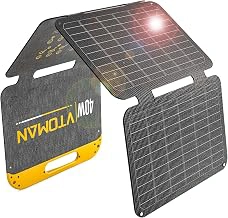
VTOMAN 40W Foldable Portable Solar Panel Charger
The VTOMAN 40W sits between compact trickle chargers and heavier high-wattage panels, delivering enough power to top off a portable station or maintain house batteries without consuming precious cargo space. At $69.99, it undercuts multiple options while folding smaller than most multiple competitors, making it a practical choice when you need real charging capacity but can't dedicate a drawer to solar gear.
Compared to the Lensunsolar multiple, the VTOMAN trades raw output for portability - it folds to roughly half the packed dimensions and weighs noticeably less, so you can stash it behind a seat or in an overhead cabinet instead of strapping it to the roof rack. Output remains high enough to recover a mid-sized battery bank over a sunny afternoon, and the foldable design means you can angle each panel section independently on uneven ground or tilted van roofs.
The included kickstands lock into place without fiddling, and corner grommets let you tie the panel down when parked on sloped sites or in gusty conditions. The carry case doubles as a padded sleeve during transit, protecting the junction box and cable ports from the hard knocks that come with frequent setup and teardown. Users with the 4.6 rating frequently mention that actual charge rates match the labeled wattage in full sun, and several note the panel holds up to repeated folding without cracked solder joints or frayed fabric - common failure points in budget foldables.
For van builders working within tight budgets and tighter storage limits, the VTOMAN 40W delivers reliable mid-range charging without the bulk or expense of a rigid multiple array. If you need to scale power later, two of these panels still pack flatter than one Renogy multiple and give you flexibility to position them separately for better sun exposure throughout the day.
- ✅ Folds to half the size of comparable 60W panels
- ✅ Kickstands and grommets simplify angled setup and tie-down
- ✅ Carry case protects junction box during frequent moves
- ✅ Actual output matches labeled wattage in direct sun
- ✅ Holds up to repeated folding without joint failures
- ⚠️ 40W output requires longer charge times than 100W+ options
- ⚠️ Smaller surface area limits performance in partial shade
- ⚠️ Budget price point may use lower-efficiency cells than premium brands
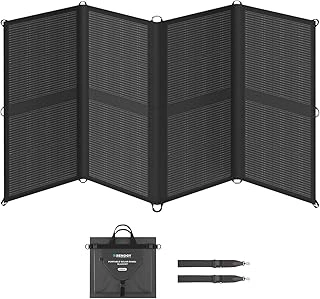
Renogy 200W Portable Foldable Solar Panel Blanket
Vanlifers who run laptops, multiple refrigerators, or other consistent electrical loads will find the Renogy 200W Portable Foldable Solar Panel Blanket delivers the highest output in the portable blanket category. The 200-watt rating provides enough headroom to charge house batteries while powering devices simultaneously, which matters when you're parked in the shade or working through cloudy spells.
This blanket folds into a carry case that measures roughly the size of a small suitcase, so you'll need to allocate dedicated storage space in your van - either under a dinette bench, in a rear garage cabinet, or strapped to a ceiling rack. At around the listed size, it's manageable for one person to deploy and repack, though the weight adds up if you're climbing on and off the roof daily.
The panel includes an integrated charge controller with alligator clips and an Anderson connector, which simplifies wiring to most multiple battery banks. If your system already has a dedicated MPPT controller, you can bypass the onboard unit, but the included hardware covers basic setups without extra purchases. Cable length is adequate for roof deployment on standard-height cargo vans; taller ProMaster or Sprinter builds may want an extension.
Fold points use reinforced stitching and durable fabric backing, designed to handle repeated setup and breakdown. The panels themselves carry a standard ETFE coating that resists light rain and dust, though Renogy recommends avoiding prolonged submersion. Users who deploy the blanket daily report that hinges hold up well over months of use, but storing the unit damp or folding it while wet can shorten lifespan.
The 200-watt output justifies the larger storage footprint if your electrical budget regularly exceeds multiple-hours per day. For lighter users who primarily charge phones and run LED lighting, a smaller blanket will pack more efficiently and cost less. Priced at $201.87, this option makes sense when your van's electrical system is already sized for higher draw and you have the interior real estate to stow it properly.
- ✅ 200-watt output supports laptops, fridges, and simultaneous device charging
- ✅ Integrated charge controller with alligator clips and Anderson connector included
- ✅ Reinforced fold points hold up to daily deployment and repacking
- ✅ ETFE coating provides weather resistance for outdoor use
- ⚠️ Larger fold size requires dedicated storage space in van interior
- ⚠️ 17-pound weight makes roof deployment more demanding for solo users
- ⚠️ Higher price point less justified for light electrical loads under 50 Ah/day
Head-to-Head: Watts, Weight, and Fold Dimensions
Choosing the right solar blanket starts with understanding how wattage, weight, and packed dimensions align with your van's roof space and daily power needs. The three blankets in this guide represent distinct points on the efficiency curve: the 30W option packs into a space no larger than a rolled camping mat, the 100W strikes a middle ground for weekend trips, and the 200W delivers serious output at the cost of bulk and mounting logistics.
Wattage determines how much energy you can harvest during peak sun hours. A 30W blanket might generate 120 - 150 watt-hours on a good day, enough to top off a phone, laptop, and small LED lights. The 100W version can deliver 400 - 500 watt-hours under ideal conditions, supporting a compressor fridge or multiple device charges. The 200W model pushes into the 800 - 1,000 watt-hour range, handling extended off-grid stays or higher-draw appliances like induction cooktops and power tools.
Weight matters when you're stowing panels inside the cab or strapping them to a roof rack. The 30W blanket typically weighs under 2 pounds, while the 100W sits around 6 - 8 pounds, and the 200W can exceed 15 pounds. Fold dimensions follow a similar progression: compact options collapse to roughly 12 × 8 × 2 inches, mid-range units fold to about 18 × 14 × 3 inches, and high-output blankets may measure 24 × 18 × 4 inches or larger when stowed.
Price per watt reveals the cost-efficiency tradeoff. Ultra-compact 30W models often run $3 - $4 per watt due to specialized materials and portability engineering. Mid-range 100W blankets drop to $2 - $2.50 per watt, while 200W versions can hit $1.50 - $2 per watt, rewarding buyers who prioritize output over packability. Included accessories vary: budget models ship with basic alligator clips, while premium kits bundle charge controllers, MC4 extension cables, and padded storage bags.
The core tradeoff is simple. If roof space is tight and you move the panel daily, a lighter, smaller blanket wins even if the per-watt cost is higher. If you have a permanent roof rack and need to run a fridge or heater fan, the 200W option's bulk becomes worthwhile. Measure your available storage, calculate your average daily watt-hour consumption, and match the blanket's output to your minimum viable charge rate rather than chasing maximum wattage you may never fully deploy.
Deciding Which Solar Blanket Fits Your Van Build
- Measure your available roof or storage space - fold dimensions matter more than unfolded size
- Calculate your daily watt-hour needs: lights, fridge, laptop, and charging devices
- Check your charge controller compatibility - some blankets need MC4 adapters
- Decide if you'll deploy on the ground or mount semi-permanently on the roof
- Factor in weight if you plan to move the blanket frequently or hike to a sunny spot
- Consider whether built-in grommets or a carry case will simplify your setup
Making the Right Choice for Your Van's Power System
Your best choice depends on three factors: how much daily power you draw, how much roof or storage space you can dedicate to solar, and whether this blanket will be your primary charger or a supplemental option. The Renogy 200W makes sense for users running fridges, laptops, or other continuous loads who need to harvest the most wattage in limited sunlight hours. It's heavier and more expensive, but the output justifies the investment if you're off-grid for extended stretches. The VTOMAN 40W balances usability and price for weekend travelers or those using solar as a secondary source alongside shore power or alternator charging. It's light enough to move around for sun tracking and delivers enough power to keep phones, lights, and small devices topped off. The Lensunsolar 30W works as an ultralight backup for minimalist builds or as an emergency option tucked into a side compartment. It won't power much on its own, but it can trickle-charge a battery or run small USB loads when you're not driving.
None of these options will single-handedly support a high-draw build with air conditioning or power tools, and all perform best in direct, unshaded sunlight. If your roof is already crowded with rigid panels, a foldable blanket gives you flexibility to add capacity when parked without committing to permanent mounts. If you have no other charging infrastructure, start with the Renogy 200W and expand from there. Evaluate your typical daily watt-hours, measure your available storage, and choose the blanket that fits your realistic power budget rather than aspirational convenience.