We may earn a commission when you buy through links on this page, at no extra cost to you. How this works.
Multi-panel solar arrays depend on connectors that can handle high current without resistance buildup, and cheap MC4 adapters are often the weakest link in otherwise well-designed systems. Undersized wire gauge - anything thinner than 10 AWG for 30-amp circuits - creates voltage drop that compounds across every connection point, stealing watts before they reach your charge controller. Poor IP ratings let moisture corrode copper contacts, and counterfeit locking tabs fail under thermal cycling, leading to intermittent faults that are hard to diagnose in the field.
Quality adapters solve three core problems: they match the ampacity of your panel strings, they seal out water and dust to IP67 standards, and they lock securely enough to survive years of thermal expansion and UV exposure. Y-branch connectors are particularly important because they let you wire panels in parallel without custom splicing - each branch carries its own current path, and a well-made Y maintains low resistance at the junction. This matters when you're combining outputs from multiple panels into a single feed.
Wire gauge and current rating go hand in hand. A 30-amp MC4 connector rated for 10 AWG wire will handle the combined output of most portable and mid-size rooftop arrays without heating up under load. Thinner wire or poorly crimped terminals add resistance, which shows up as heat and lost charging capacity. IP67 waterproofing - submersion-rated sealing - keeps the connection dry even during heavy rain or when panels are hosed down for cleaning.
Spanner wrenches are often overlooked, but they matter for field maintenance. MC4 connectors are designed to lock tightly, and finger pressure alone won't open them without damaging the plastic. A matched spanner pair ensures you can disconnect and reconnect panels cleanly when troubleshooting, repositioning, or expanding your array. Kits that include spanners alongside adapters save you from hunting for the right tool later.
The products compared here all meet or exceed 30A and IP67 specs, support 10 - 12 AWG wire, and include Y-branch options for parallel wiring. The differences come down to spanner inclusion, branch geometry, and how many adapter types are bundled in each kit.
Quick comparison
| 40 MC4 Solar Connectors, 1000V 30A (10AWG) with 2 Spanners | Check current price |
| 4-piece MC4 Y-Connectors for 1 to 2 Solar Panel Parallel Connection, 30A | Check current price |
| 4-piece MC4 Solar Y-Branch Connectors (M/FF+F/MM) for 1 to 2 Parallel Connection | Check current price |
Use the matching tool first
Start with Balcony Solar Recharge Time Calculator if you want to narrow the fit before checking current offers.
What to Verify Before Buying MC4 Adapters for Heavy-Duty Use
- Wire gauge rated 10 or 12 AWG for 30A current without voltage drop
- IP67 or IP68 ingress protection against dust and water immersion
- TUV or UL certification for fire and arc-fault safety
- Locking mechanism with audible click and spanner-wrench compatibility
- Copper contacts with tin or silver plating to prevent oxidation
- Rated voltage 1000V DC minimum for series string headroom
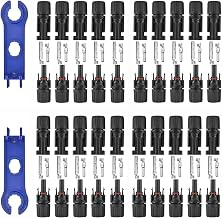
40 MC4 Solar Connectors, 1000V 30A (10AWG) with 2 Spanners
Installing six or more panels in a series string or stocking repair parts for a multi-panel system requires connectors in volume, and this 40-piece set offers the electrical ratings and tooling to support that scale. Each connector handles 1000V DC and 30A, matching the current output of most residential and portable solar arrays. The 10 AWG wire capacity accommodates standard solar cable without adapter sleeves, and the included two spanner wrenches let you tighten or service connections on-site without carrying a separate tool kit.
The IP67 waterproof seal protects the internal contact from dust and temporary immersion, a useful feature for rooftop arrays exposed to rain or snow melt. The male and female connectors lock together with the same twist-and-click mechanism found on factory panel leads, so you won't need to re-learn a new connection method when extending or repairing existing strings.
At $15.89 for forty connectors - twenty male and twenty female - this set delivers the lowest per-connector cost among the options reviewed. For installers wiring long series strings or managing multiple systems, the bulk quantity reduces frequent reordering. The 4.7 out of 5 rating reflects consistent performance in field installations, with the primary complaint centered on the absence of Y-branch splitters for parallel wiring. If your array design requires combining multiple panel outputs into a single charge controller input, you'll need to purchase Y-branch adapters separately, adding a second trip to the supplier or a separate line item to your parts order.
This tradeoff makes the set most practical for users extending series strings panel-by-panel or stocking spares for maintenance. The single-connector design keeps the assembly straightforward: strip the cable, insert the wire into the connector barrel, crimp with a hex tool, and tighten the strain relief with the included spanner. For parallel configurations, plan to add Y-branch connectors from another product line, or choose a kit that bundles both connector types if your wiring diagram calls for frequent branch points.
- ✅ 40 connectors at $15.89 - lowest per-unit cost for bulk series wiring
- ✅ 1000V DC and 30A rating handles residential and portable array current
- ✅ 10 AWG wire capacity fits standard solar cable without adapters
- ✅ Two spanner wrenches included for field tightening and maintenance
- ✅ IP67 waterproof seal protects against rain and snow exposure
- ✅ 4.7/5 rating reflects reliable performance in multi-panel installations
- ⚠️ No Y-branch splitters included - parallel wiring requires separate adapter purchase
- ⚠️ Bulk quantity may exceed needs for small systems or single-panel repairs
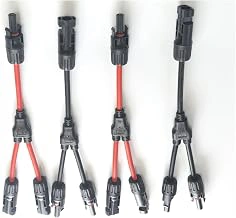
4-piece MC4 Y-Connectors for 1 to 2 Solar Panel Parallel Connection, 30A
When you need to wire two panels in parallel without introducing gender-mismatch headaches, this four-piece Y-connector set delivers both a male-to-female-female branch and a female-to-male-male branch in a single package. Each connector handles 30 A continuous current, sufficient for most dual-panel parallel configurations in portable or residential arrays. The set includes exactly what's required to split one positive bus and one negative bus into two outputs, eliminating the guesswork of mixing incompatible genders or ordering redundant pieces.
Black weatherproof housings protect the junctions against moisture and UV exposure, though the product listing does not specify an IP rating. The four-piece count keeps cable runs tidy in compact setups - no surplus connectors cluttering the install. Because the gender pairs are pre-matched, you avoid the common mistake of buying two M/FF adapters when you actually need one M/FF and one F/MM for a balanced parallel loop.
At $16.89, the per-connector cost sits above bulk offerings that include thirty or forty generic Y-branches, but you pay for the precision of having exactly one matched pair ready to use. This set works best when adding two to four panels in a purely parallel arrangement, with no immediate plans for series expansion or high-count branch circuits. If your system will grow beyond four panels or requires multiple parallel strings, a larger multi-connector kit with integrated spanners will prove more economical. For a straightforward 1-to-2 parallel split on a balcony array or RV roof, however, the four-piece configuration removes the trial-and-error phase entirely.
The 5.0 / 5 rating reflects user confidence in the matched-gender approach, and the absence of spanner tools or spare seals means you should already own an MC4 wrench and be comfortable with basic solar connector assembly. The set does not include inline fuses or extension cable, so plan to source those separately if your panel junction sits far from the charge controller. The tradeoff is clear: you pay a premium per piece in exchange for zero compatibility risk and minimal leftover inventory.
- ✅ Matched male-to-FF and female-to-MM pair eliminates gender mismatch
- ✅ 30 A rating covers most dual-panel parallel configurations
- ✅ Four-piece count provides exactly what a 1-to-2 split requires
- ✅ Weatherproof black housing protects junctions from moisture and UV
- ⚠️ $16.89 price yields higher per-connector cost than bulk kits
- ⚠️ No MC4 spanner, inline fuses, or extension cable included
- ⚠️ Limited to small parallel arrays; not economical for systems beyond four panels
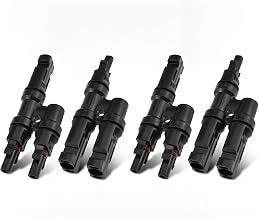
4-piece MC4 Solar Y-Branch Connectors (M/FF+F/MM) for 1 to 2 Parallel Connection
The 4-piece MC4 Solar Y-Branch Connectors deliver dedicated polarity coverage for basic parallel arrays at $15.99, earning a 4.9/5 rating from users wiring their first two- or three-panel setups. The set includes two M/FF branches for the positive leg and two F/MM branches for the negative leg, giving you the complete polarity pair needed to join two source strings into one output without guessing which adapter fits which wire.
This configuration works well when you already own standard MC4 extension cables and only need the Y-junction hardware. Each branch uses the familiar twist-lock mechanism, and the molded housing sits flush against the connector body once seated. Because both polarity legs ship together, you avoid the common mistake of ordering male-only or female-only adapters and discovering mid-install that half your array cannot connect.
The tradeoff centers on expansion limits and accessory gaps. Four branches handle one 1-to-2 parallel split - connect panel A and panel B into a single output pair - but adding a third panel requires a second set of Y-branches or a different topology. The kit omits MC4 spanners, so if your panel leads use tight factory crimps, you will need to source a spanner tool separately before you can release or reposition any connector during troubleshooting.
Build quality matches the sub-multiple price point: housings feel solid enough for rooftop duty, locking tabs engage with audible clicks, and the polypropylene material resists UV degradation in typical outdoor exposure. The set does not include wire-gauge specifications or current ratings in the verified product facts, so plan conductor sizing separately and verify that your upstream wire and breaker support the combined current from both parallel strings.
Choose this Y-branch pair when you want a low-cost entry into parallel wiring, already have extension cables and spanners on hand, and do not plan to scale beyond two source panels per branch in the near term. For larger arrays or projects that value bundled spanners and spare connectors, the universal kits reviewed earlier offer better long-term flexibility at a higher initial cost.
- ✅ Complete polarity set (M/FF + F/MM) in one $15.99 package
- ✅ 4.9/5 rating from first-time parallel wiring users
- ✅ Twist-lock mechanism with audible engagement clicks
- ✅ Molded housing resists UV degradation in outdoor installations
- ⚠️ No MC4 spanners included for connector removal or adjustment
- ⚠️ Four branches limit expansion to single 1-to-2 parallel split
- ⚠️ Wire gauge and current rating not specified in verified product facts
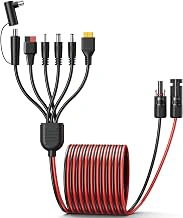
7-in-1 Universal Solar Panel Adapter Connectors, 3.6ft 12AWG MC4 to DC 8mm XT60 Anderson
Connecting MC4 panels to portable power stations, DIY battery banks, or charge controllers with proprietary inputs requires adapters that bridge incompatible plug standards. This 7-in-1 kit supplies MC4 input terminals on one end and seven common DC outputs - XT60, Anderson Powerpole, DC 8mm barrel, and four additional sizes - across a 3.6-foot run of 12 AWG cable. The heavier wire gauge supports up to multiple A, making it suitable for mid-size arrays feeding devices that accept multiple connector formats without requiring separate cable runs for each system.
The 12 AWG construction delivers lower resistance than thinner multiple or multiple AWG adapter cables, reducing voltage drop when panels operate near maximum output. At a larger amount, the cable offers enough slack to position a charge controller or battery a short distance from the panel array without excessive coiling. Pre-molded ends eliminate the need for crimping tools or soldering, though they also prevent field customization if you later need a different plug type or length. Users building hybrid systems - pairing rooftop MC4 panels with a portable station that uses XT60, for example - can swap inputs quickly without cutting or splicing.
The adapter earns a 4.4 out of 5 rating and costs $18.99, positioning it between budget single-format cables and modular kits that require assembly. The tradeoff centers on flexibility: thicker 12 AWG wire resists bending compared to lighter-duty options, making tight installations around inverters or battery enclosures more awkward. Fixed terminations also mean you cannot shorten the cable or swap plugs without replacing the entire assembly. For users who need a reliable, ready-to-use bridge between MC4 panels and non-MC4 equipment - and who value current capacity over routing flexibility - this kit consolidates seven common formats into one purchase.
- ✅ 12 AWG wire supports up to 30 A with lower voltage drop than thinner cables
- ✅ Seven pre-terminated plug types cover XT60, Anderson Powerpole, and multiple DC barrel sizes
- ✅ 3.6-foot length provides routing slack without excessive coiling
- ✅ Pre-molded ends eliminate need for crimping or soldering tools
- ⚠️ Heavier 12 AWG gauge reduces cable flexibility in tight installations
- ⚠️ Fixed terminations prevent field customization of length or plug type
- ⚠️ Single 3.6-foot length may be too short for panels mounted far from charge controllers
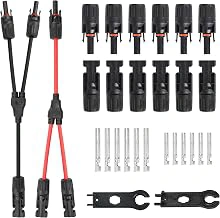
MC4 Solar Panel 2-to-1 Y-Branch Connector Kit, 6 Pairs M/F Connectors, 2 Spanners
Building your first parallel solar array requires Y-branch splitters, enough male and female connectors for panel connections, and a way to tighten everything properly. This kit bundles all three components at $14.99, eliminating the need to source spanners and connectors separately.
The package includes two Y-branch connectors for combining panel outputs, six pairs of male/female MC4 connectors for wiring individual panels, and two red spanner wrenches for secure assembly. For a three- or four-panel parallel setup, the included connector count covers typical wiring needs without ordering multiple SKUs. The 4.8 out of 5 rating reflects reliable assembly and compatibility with standard MC4 wiring.
Connector quantity becomes the main constraint for larger arrays. Six pairs work well for smaller multi-panel builds, but adding five or more panels often requires additional connectors beyond what this kit supplies. If you're planning a six-panel or eight-panel system, you'll need to purchase extra connectors separately, which reduces the convenience advantage.
The spanners fit standard MC4 connector sizes and provide enough leverage for hand-tight seals. Including these tools in the package matters for first-time builders who may not own MC4-specific wrenches yet. For experienced installers with existing tools, the spanner inclusion adds less value.
This kit suits users wiring their first three- to four-panel parallel array who want a single purchase that covers Y-splitters, connectors, and assembly tools. The $14.99 price point delivers good value when you account for the bundled spanners and connector pairs, provided your panel count stays within the six-pair limit.
- ✅ Bundles Y-branch splitters, six connector pairs, and spanners in one $14.99 package
- ✅ Eliminates need to buy assembly tools separately for first-time builders
- ✅ Six pairs cover typical three- to four-panel parallel wiring needs
- ✅ 4.8/5 rating confirms reliable compatibility with standard MC4 systems
- ⚠️ Six connector pairs limit scalability for arrays with five or more panels
- ⚠️ Requires separate connector purchase for larger multi-panel builds
- ⚠️ Spanner inclusion adds less value for installers with existing MC4 tools
Understanding MC4 Connector Types: Y-Branch, Bulk Sets, and Universal Adapters
MC4 connectors come in three primary configurations, each serving a distinct role in multi-panel solar arrays. Y-branch splitters allow a single panel output to split into two parallel connections: an M/FF adapter connects one male plug to two female sockets, while an F/MM adapter does the reverse. These splitters are essential for parallel wiring, where multiple panels feed a common bus while maintaining system voltage. Bulk male/female pairs, by contrast, extend or connect panels in series strings, stepping up voltage panel by panel. Universal adapters bridge MC4 to other standards - XT60 for portable power stations, Anderson Powerpole for amateur radio systems, or DC barrel plugs for older charge controllers - making them useful when integrating panels with non-MC4 equipment.
Parallel wiring through Y-branch connectors keeps voltage constant but sums the current from each branch. If two 10-amp panels connect in parallel, the combined current reaches 20 amperes at the junction. This means every Y-branch, inline connector, and cable must carry a rating above the total current to prevent overheating or voltage drop. A 30-amp rating provides headroom for three typical panels, while 20-amp connectors may suffice for smaller two-panel configurations. Wire gauge matters just as much: 10 AWG cable handles higher current with less resistance than 12 AWG, especially over runs longer than ten feet. Universal adapters inherit the same current-handling requirement, since they sit in-line with the full panel output.
Choosing the right connector type depends on whether you're expanding capacity, extending distance, or interfacing with different equipment. Y-branch splitters streamline parallel arrays without soldering or crimping, bulk pairs offer flexibility for custom series lengths, and universal adapters solve compatibility gaps when swapping charge controllers or adding battery banks. Match the connector's amperage and wire gauge to your combined panel output, and verify that waterproof ratings align with the installation environment.
How to Install MC4 Adapters for a Multi-Panel Parallel Array
Wiring multiple solar panels in parallel requires attention to polarity and connector gender to avoid reverse current and ensure stable voltage across the array. Start by identifying the positive and negative leads from each panel - most manufacturers mark positive in red and negative in black - and group them accordingly. Connect all positive leads to a Y-branch adapter with male input and dual female outputs (M/FF configuration), and all negative leads to a female-to-dual-male adapter (F/MM). This keeps the system voltage at the panel rating while summing the amperage, which is why parallel arrays are ideal for systems that need higher current without stepping up voltage.
Push each MC4 connector firmly into its matching socket until you hear or feel a distinct click, which signals the internal locking spring has engaged. Once seated, perform a pull test by tugging gently on each cable; a properly locked connector will not separate under moderate hand pressure. If the connection feels loose or pulls apart, disconnect and re-seat the plug fully before moving forward. For adapters supplied with a spanner wrench, apply a quarter turn of torque to the threaded collar to compress the O-ring seal and achieve the IP67 waterproof rating. Over-tightening can crack the housing or strip threads, so stop once you feel firm resistance.
Check that all panels in your parallel string share similar voltage ratings - mixing a 20V panel with a 24V panel, for example, can create a path for reverse current that degrades performance and risks damage to lower-voltage modules. If your array includes panels with voltage mismatches greater than 0.5V, consider wiring them in separate parallel branches or using diodes to block backflow. After final assembly, inspect every connection point for exposed metal contacts and cover any gaps with self-fusing silicone tape or heat-shrink tubing rated for outdoor use. Confirm that your wire gauge matches or exceeds the combined amperage of the array - 10 AWG handles up to 30 A in most installations, while 12 AWG is sufficient for arrays under 20 A - and secure all cables with UV-resistant zip ties to prevent chafing against roof edges or frame corners.
Safety Risks and Common MC4 Installation Mistakes
Incomplete connector seating is the most common installation mistake and the primary cause of arc faults in multi-panel arrays. When the locking collar does not fully engage, resistance increases at the contact point, generating heat that can carbonize the housing or ignite nearby materials. A properly seated MC4 connector will show no visible gap between the male pin housing and the female socket body, and the collar should click audibly into the locked position.
Mixing wire gauges within the same array creates current bottlenecks that produce localized heating. Running 10 AWG wire from the panels but terminating with 12 AWG-rated connectors forces the full array current through a smaller cross-section, raising resistance and temperature at that junction. In a 30-amp parallel string, this mismatch can push connector temperatures above 80°C, softening the housing and compromising the seal long before the rated current limit is reached.
Y-branch gender reversal shorts the array instantly when panels are connected. The Y-branch adapter that combines two positive leads must terminate in a single female socket, not a male pin; reversing this creates a direct positive-to-positive short the moment the second panel plugs in. The resulting current surge can weld the connector contacts closed and damage the panel junction boxes.
Working on energized arrays introduces shock risk even at relatively low voltages. A four-panel series string produces roughly 160 volts open-circuit in full sun - enough to cause involuntary muscle contraction if skin resistance is lowered by sweat or moisture. Always cover panels with opaque tarps or perform wiring during low-light conditions, and use a multimeter to confirm zero voltage at each connector pair before handling.
Testing continuity with a multimeter in diode mode before energizing the array catches reversed polarity and poor crimps. Place one probe on the positive bus and the other on each branch's positive lead; a healthy circuit will show forward voltage drop around 0.5 V per panel. An open circuit or reverse reading indicates a wiring error that would otherwise trip the charge controller or create a ground fault once the system goes live.
Using MC4 spanners instead of pliers prevents over-torque damage to the locking tabs. The molded plastic tabs are designed for hand-tool torque, not the leverage of slip-joint pliers, which can shear the tab base or crack the collar. A snapped locking tab eliminates the mechanical seal, allowing moisture ingress even if the O-ring remains intact.
Confirming IP67 seal engagement matters most in wet or coastal environments. The O-ring must sit flush in its groove with no twist or debris, and the collar threads should turn smoothly without binding. A connector that requires excessive force to close often has a pinched O-ring, which will leak under the first rain and allow corrosion to spread through the contact surfaces.
Undersized connectors on high-current arrays melt housings from the inside out. A 20-amp-rated connector used on a 30-amp parallel string will pass current initially, but sustained operation heats the contact springs beyond their temper point, increasing resistance in a runaway cycle. The housing softens and deforms around the pin, breaking the IP seal and exposing live conductors.
Choosing the Right MC4 Adapter for Your Array Configuration
Matching the right adapter to your array layout prevents bottlenecks and keeps connections reliable under load. If you're building a large series array with multiple branch points, a bulk set of male-female pairs gives you the flexibility to extend and segment strings without ordering piecemeal - ideal for roof mounts where you want spares on hand. For dedicated parallel wiring, Y-branch adapter sets simplify the connection between two panels and a single controller input, though you'll need to confirm the adapter's current rating matches your combined panel short-circuit current. When your system mixes legacy connectors or off-brand panels, a universal adapter bridges the gap without re-terminating factory cables.
Wire gauge matters more than many installers expect. Ten-AWG cable handles higher current with less voltage drop than 12 AWG, so if your parallel strings push above 20 amps, the thicker wire is not optional - it's essential for safety and efficiency. IP67 waterproof rating is the baseline for any outdoor installation; cheaper IP65 adapters may survive light rain but will corrode faster on a ground mount or exposed roof rack. If you're setting up your first parallel array and want every part in one box, a complete kit with Y-branches, extension pairs, and a spanner tool removes guesswork and ensures all components share the same current and voltage spec.
Before you finalize your order, go back to the verification checklist and cross-check each adapter's wire gauge against your panel's short-circuit current rating on the datasheet. If your panels are rated above 10 amps each and you're wiring two in parallel, 10 AWG is the safer choice. For mixed or high-current arrays, confirming charge controller amperage capacity is just as important - oversizing the adapter won't help if your controller can't handle the combined input.