We may earn a commission when you buy through links on this page, at no extra cost to you. How this works.
When the power goes out in an apartment, your options narrow quickly. Gas generators are banned in most multifamily buildings because of carbon monoxide risk and fire codes. Extension cords from a neighbor's unit violate lease terms. That leaves solar generators as the only practical backup power source for renters and condo owners who need to keep essentials running during an outage.
Apartment emergency kits face constraints that suburban setups do not. Storage space is measured in closet inches, not garage square footage. Charging happens on a balcony or patio, not a south-facing roof. Noise restrictions often cap decibel levels during certain hours, and homeowners associations may regulate what equipment you can place outdoors. A compact solar generator solves these issues by fitting under a desk, charging from a single folding panel, and running silently.
Capacity expectations matter. A 300 - 500 watt-hour unit will power a phone, laptop, small fan, and LED lights for one to two days of rationed use. It will not run a full-size refrigerator or window air conditioner for extended periods. If your goal is to maintain communication, charge medical devices, and preserve a few perishables in a cooler with ice packs, compact models deliver enough output without requiring a pickup truck to move them.
The three generators reviewed here were selected because they meet apartment-specific criteria: weight under 15 pounds, footprint smaller than a carry-on suitcase, balcony-compatible solar input, and verified capacity ratings that match real emergency loads. Each includes multiple AC, USB, and DC ports so you can prioritize what stays on when the grid does not.
Use the matching tool first
Start with Balcony Solar Recharge Time Calculator if you want to narrow the fit before checking current offers.
Key Features That Make a Solar Generator Apartment-Friendly
A solar generator suitable for apartment emergency kits must fit spaces that outdoor-oriented models ignore. Capacity in the 150 - 300 watt-hour range balances runtime for essential devices - LED lights, phones, a small fan - with a footprint that sits comfortably on a closet shelf or under a bed. Units above 300Wh often exceed ten inches in width and weigh more than eight pounds, making them awkward to carry to a balcony for solar charging or to relocate when storage priorities shift.
Weight matters because apartment dwellers rarely leave equipment outdoors. If you need to move a unit to a south-facing window or balcony railing each morning, anything heavier than eight pounds becomes a chore. Silent operation is equally important: shared walls and floors mean fans or cooling systems louder than conversation will draw complaints during extended outages, especially at night.
Pass-through charging lets you connect a portable solar panel on the balcony while the generator powers devices inside. Without this feature, you must choose between recharging or using stored energy, cutting effective uptime in half. LiFePO4 battery chemistry holds charge longer between rotations - critical when an emergency kit may sit untouched for months - and tolerates more charge cycles than older lithium-ion cells, extending the unit's useful life before capacity drops noticeably.
Oversized 'portable' stations marketed for RVs or job sites often miss these marks. They deliver high wattage and long runtime but demand garage storage, require two-handed carries, and include cooling fans that hum loud enough to wake neighbors. For apartments, smaller dimensions and quieter electronics prove more valuable than maximum output.
Capacity vs. Size: Matching Generator Output to Your Apartment Emergency Needs
Choosing the right capacity starts with knowing what you need to keep running during an outage. Watt-hours (Wh) represent the total energy a solar generator can store, and matching that number to your actual apartment emergency loads prevents both over-spending and coming up short when the power goes out.
A 150Wh unit delivers roughly 10 - 12 smartphone charges, 15 - 20 hours of LED desk-lamp light at 8 watts, or 3 - 4 hours for a Wi-Fi router drawing 10 - 12 watts. This tier works for minimal emergency communication: keeping one phone alive, a single light on, and perhaps a battery bank topped off overnight. If your priority is texting updates and charging one device at a time, 150Wh covers that scenario without taking up closet space.
At 192Wh, you gain flexibility for simultaneous loads. Expect 12 - 15 phone charges, 20 - 25 hours of LED lamp runtime, or 4 - 6 hours of router uptime alongside a phone charge. This capacity suits apartments where you want connectivity and light running together during a six- to eight-hour evening blackout, or where two people need device power without rationing every outlet cycle.
A 288Wh generator steps into multi-device territory. You can run a laptop for 4 - 5 hours at 50 watts, keep the router live for 8 - 10 hours, and still charge phones twice over. Alternatively, power a small 30-watt fan for nine hours on a hot summer night, or keep a medication mini-fridge drawing 40 watts cool for six to seven hours. This tier makes sense when your emergency kit includes medical devices, work-from-home equipment during grid instability, or shared household needs that go beyond bare-minimum communication.
To self-assess, list your three most critical devices, note their wattage (check the label or power adapter), and multiply by the hours you expect to bridge. Add 20 percent for inverter efficiency loss. If the total stays under 120Wh, the smallest tier suffices. Between 120Wh and 230Wh, the mid-range avoids cutting it close. Above that, or if you plan to recharge the generator daily from a balcony panel and cycle through higher loads, 288Wh provides the overhead to avoid deep discharge stress and extend battery lifespan.
Capacity and physical size do not scale linearly. A 288Wh unit may weigh only two pounds more than a 150Wh model but offer nearly double the usable energy, because lithium cells pack density efficiently at certain thresholds. The tradeoff comes in recharge time: topping off 288Wh from a small 60-watt panel takes roughly five sunny hours, while 150Wh can fully recover in under three. Consider how often you can access balcony sun and whether overnight indoor storage between charge cycles fits your routine.
What These Generators Won't Power (and Why That's Fine for Apartment Emergencies)
Compact solar generators sized for apartment storage will not run high-wattage heating or cooking appliances. Space heaters, which draw 1,000 to 1,500 watts, exceed the continuous output of units in the 300 to 600 watt range. Microwaves and electric kettles demand similar power, making them impractical for small-capacity emergency systems. Hair dryers and window air conditioners also fall outside the capability of these generators.
Window AC units typically pull 500 to 1,200 watts, and even compact personal models require sustained current that drains smaller battery banks in under an hour. Coffee makers, toasters, and electric space heaters share the same limitation: their resistive heating elements consume more power than a compact generator can supply without triggering overload protection or shutting down.
Apartment emergency power should focus on communication and essential safety rather than comfort appliances. Charging phones, tablets, and laptops keeps you connected to emergency services and family. LED lanterns and flashlight batteries provide lighting without consuming meaningful capacity. Small fans designed for USB or 12-volt operation circulate air using a fraction of the wattage an AC unit demands.
Medication refrigeration becomes possible with portable 12-volt coolers that draw 40 to 60 watts, well within the range of compact generators. A 300-watt-hour battery can run a small cooler for several hours, preserving insulin or other temperature-sensitive prescriptions during an outage. Portable radios and weather alert receivers use minimal power, and a compact generator will keep them running for days.
Understanding these this product prevents disappointment and helps you build a realistic emergency kit. Compact solar generators serve as backup communication hubs and lighting sources, not replacements for grid-powered heating or cooking. If your apartment emergency plan requires powering a CPAP machine, refrigerator, or other moderate-draw medical device, verify the specific wattage and runtime before choosing a model. For most apartment residents, a compact unit covers the essentials - phone, light, radio, and small electronics - without the bulk or cost of larger systems designed for whole-home backup.
Balcony Solar Charging: How Much Sun You Actually Need
Balcony charging sounds ideal until you realize most apartment balconies receive 4 - 6 hours of interrupted sunlight on good days. Neighboring buildings cast moving shadows, many balconies face north or east with limited direct exposure, and seasonal sun angles shift the usable charging window by several hours between summer and winter.
Under typical apartment conditions - partial shade, non-south orientation, or morning-only sun - expect charging times to double or triple compared to manufacturer specs. A 100W panel that promises a full charge in 8 hours under perfect lab conditions may need 16 - 24 hours of real-world balcony exposure. If your balcony gets strong afternoon sun from April through September, solar becomes a practical supplement. If it sits in shade most of the day or faces away from the sun's path, plan on wall outlet charging as your primary method and use solar only when extended outages coincide with clear weather.
North-facing balconies receive almost no direct sun in winter months across most of the northern hemisphere. East-facing balconies capture morning light but lose it by noon. West-facing units get afternoon heat but may sit in shadow until late morning. South-facing balconies offer the longest daily window, though nearby towers or trees still interrupt the beam. Before committing to solar as your main recharge strategy, track sunlight on your balcony for a week and note the hours when a panel could sit unobstructed.
Panel positioning matters more in tight spaces. Compact units ship with panels that need angling toward the sun, but balcony railings, furniture, and building overhangs limit placement. Propping a panel against a railing may block part of the cell array or create a shallow angle that cuts efficiency by 30% or more. If you cannot adjust tilt throughout the day, accept lower harvest rates and longer sessions.
Use wall outlet charging to top off your generator every few months during normal times. Treat balcony solar as the backup recharge method when grid power is unavailable and weather cooperates. This approach keeps your emergency kit dependable without relying on inconsistent rooftop-level sunlight that most apartments simply do not offer.
Which Generator Fits Your Apartment Emergency Scenario
Your apartment emergency priorities determine which generator makes the most sense. If your goal is keeping phones charged and a small lamp running during short blackouts, the MARBERO 167Wh unit delivers the lightest footprint and includes its own 18W solar panel - ideal for a balcony shelf or closet corner. It weighs just 3.97 pounds, charges from empty in four hours via wall outlet, and offers USB-A, USB-C, DC, and AC ports without demanding much storage space.
For renters who need a bit more runway - powering a Wi-Fi router, charging multiple devices, and running a small fan or CPAP overnight - the DaranEner NEO300 strikes a practical middle ground. Its 296Wh capacity and 300W inverter handle broader loads without the premium price tag, and the 13-pound weight remains manageable for apartment stairs or relocation. You'll pair it with a separate 100W panel if balcony charging matters, but the unit itself fits under a bed or in a hall closet.
When you're preparing for extended grid interruptions or need confidence that a medical device, refrigerator, or window AC will stay online, the Anker SOLIX C300 provides 288Wh and a 300W continuous inverter with surge capacity up to 600W. Its LiFePO₄ battery endures more than 3,000 charge cycles, the UPS mode switches in 20 milliseconds during outages, and the 7.6-pound chassis travels easily between rooms. This option suits apartment dwellers who view their emergency kit as a long-term investment rather than a minimal hedge.
Each generator addresses a different slice of apartment readiness: communication continuity, multi-device balancing, or serious backup power. Match your scenario to the capacity, weight, and feature set that aligns with your space constraints and risk tolerance.
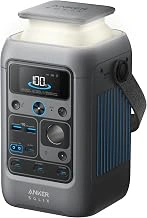
Anker SOLIX C300 DC Portable Power Station, 288Wh, 300W
The Anker SOLIX C300 DC delivers 288Wh of capacity and 300W continuous output in a package that fits neatly on a kitchen counter or bedroom shelf. For apartment dwellers who want backup power that charges from a balcony solar panel and keeps essentials running during grid outages, this unit balances usable runtime with storage-friendly dimensions.
At 288Wh, the SOLIX C300 provides enough stored energy to charge a smartphone multiple times, keep a Wi-Fi router online for multiple, or power an LED desk lamp through a full night. The 300W continuous output handles devices that draw moderate wattage - small fans, laptop chargers, a multiple CPAP machine, or a multiple DC portable fridge - without tripping the inverter. Because this is a DC model, it omits AC outlets and focuses on USB-A, USB-C, and multiple DC ports, which reduces internal heat and noise while keeping weight under control.
Anker's design includes an LED display that shows remaining capacity in percentage and watts, so you can track usage in real time. The unit accepts solar input through a standard barrel connector, making it compatible with foldable panels rated multiple that fit on a balcony railing or small patio. Recharge time from a multiple panel runs multiple in full sun, or you can top it off from a wall outlet in roughly the same window.
Dimensions measure approximately multiple × multiple × a larger amount, and the built-in handle makes it easy to move from closet to bedside during a blackout. The enclosure is plastic rather than aluminum, which keeps the price at $199.99 but means you'll want to avoid dropping it on hard surfaces. Anker's reputation for customer support and firmware updates adds confidence that the battery management system will protect cells over hundreds of charge cycles.
The tradeoff for this capacity and output is cost - budget multipleh units often retail closer to multiple. You're paying for the Anker name, a clearer display, and more robust DC output ports. If your emergency kit prioritizes phones, tablets, and a router over high-wattage appliances, and you value a brand with accessible support, the SOLIX C300 justifies the premium. Apartments with balcony access to sunlight will appreciate the straightforward solar pairing, while renters in interior units can still rely on wall charging between power events.
- ✅ 288Wh capacity provides extended runtime for phones, router, and LED lighting
- ✅ 300W continuous output supports CPAP machines and small fans
- ✅ LED display shows real-time capacity percentage and wattage draw
- ✅ Compatible with 60 - 100W foldable solar panels for balcony charging
- ✅ Compact 10 × 7 × 7 inch footprint fits apartment storage
- ⚠️ $199.99 price point higher than budget 200Wh alternatives
- ⚠️ DC-only design omits AC outlets for standard plug devices
- ⚠️ Plastic enclosure less durable than metal-clad competitors
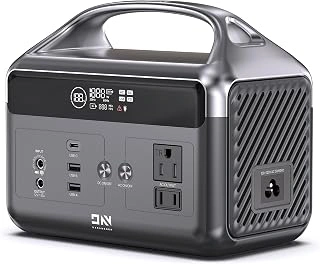
DaranEner Portable Power Station 300W (600W Peak) 192Wh LiFePO4 Solar Generator
The DaranEner 300W portable power station offers apartment dwellers an accessible entry point into backup power without the space or budget commitment of larger systems. Its 192Wh capacity translates to roughly three smartphone charges, twelve hours of LED camping lantern runtime, or enough juice to keep a small fan running through a hot afternoon - modest numbers that work for short-term communication and comfort needs but won't sustain a mini-fridge overnight.
What sets this unit apart at the $109.99 price point is its LiFePO4 battery chemistry, which typically delivers 2,multiple,multiple charge cycles compared to the multiple cycles common in lithium-ion alternatives at this size. For renters who may move apartments multiple times or store the generator on a closet shelf for months between uses, that longevity matters more than raw capacity. The 600W peak output provides a brief window to start small appliances - a blender, electric kettle, or CPAP machine - though sustained 300W continuous draw keeps you within safer operating limits.
Brand recognition remains thin, and warranty details are sparse compared to established names in the space. The compact footprint fits easily on a bookshelf or under a desk, but the lower capacity means you'll need to plan around prioritized device charging rather than multi-day autonomy. If your apartment emergency kit centers on keeping phones powered and a small light running during a six- to twelve-hour outage, the capacity trade-off becomes reasonable. Longer blackouts or higher-draw needs will expose the 192Wh ceiling quickly.
Solar compatibility allows balcony charging in principle, though the unit does not ship with panels - budget an additional purchase if you plan to recharge beyond wall outlets. The modest inverter and battery size keep weight and noise low, practical qualities when you're carrying the station up three flights of stairs or placing it near a sleeping area during a nighttime outage.
- ✅ LiFePO4 battery delivers 2,500 - 3,000 charge cycles for long-term reliability
- ✅ 600W peak output handles brief high-draw appliance starts
- ✅ Compact size fits apartment storage without monopolizing closet space
- ✅ $109.99 entry price lowers the barrier for budget-conscious renters
- ⚠️ 192Wh capacity limits runtime to short outages and priority devices
- ⚠️ Lower brand recognition and sparse warranty information
- ⚠️ No solar panel included - requires separate purchase for off-grid recharging
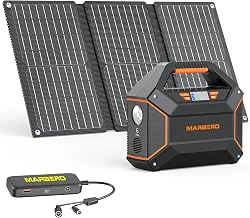
MARBERO 155Wh Solar Generator, 150W Portable Power Station with 30W Solar Panel Kit
The MARBERO 155Wh offers the smallest footprint and lowest price in this lineup, making it the most practical choice for tight apartment storage and communication-focused emergency kits. At $129.99, it includes a 30W solar panel that folds flat and charges the unit directly from a balcony railing or windowsill without additional adapter hunting.
The 155Wh battery capacity supports essential devices during short outages: a smartphone charges roughly multiple times, LED flashlights run for days, and a compact emergency radio operates for extended periods. The 150W continuous output handles USB devices, small lights, and battery-charging tasks but cannot power appliances like fans, mini-fridges, or even most laptop chargers at full load. This unit fits apartment scenarios where the priority is maintaining communication and basic lighting rather than running household electronics.
The included 30W panel generates enough power to recharge the station fully in one to two sunny days on a south-facing balcony. That slower charging speed trades convenience for portability - the panel weighs under two pounds and stores in a closet shelf or under a bed alongside the multiple-pound power station. Wall charging via AC outlet takes about four hours, a reasonable backup when weather turns cloudy.
Storage and handling favor small spaces: the compact body measures roughly the size of a toaster, and the absence of cooling fans means silent operation ideal for close quarters. The simplified control panel - one AC outlet, two USB-A ports, one USB-C port, and a DC car port - reduces bulk and keeps the interface approachable for users who want grab-and-go readiness without menu navigation.
The tradeoff lies in capacity and output. Households needing to run laptops, CPAP devices, or small kitchen appliances during longer outages will exhaust this station quickly. The 150W limit also rules out power tools, heating elements, or any device with surge draw. For apartment dwellers building a first emergency kit around phones, radios, and lights, the MARBERO delivers balcony-chargeable backup at the lowest entry cost and smallest storage commitment in this comparison.
- ✅ Smallest footprint and lightest weight for apartment closet or under-bed storage
- ✅ Includes 30W foldable solar panel for immediate balcony charging without extra purchases
- ✅ Lowest price at $129.99 for budget-conscious emergency prep
- ✅ Silent operation with no cooling fans
- ✅ Simple control panel with essential ports only
- ⚠️ 155Wh capacity limits runtime for longer outages or multiple devices
- ⚠️ 150W continuous output cannot handle laptops, CPAP machines, or small appliances
- ⚠️ 30W panel requires one to two full sun days for complete recharge
- ⚠️ No expandability or additional battery options
How to Safely Charge and Store Your Solar Generator in an Apartment
- Place solar panels on balcony railing or secure ledge during daylight only; never leave unattended overnight
- Use pass-through charging to keep the unit indoors while the panel remains outside
- Store the generator in a climate-controlled closet, away from direct sunlight and moisture
- Keep the battery charged to 50 - 80% for long-term storage to preserve cycle life
- Check HOA and lease rules for balcony solar panel use before purchase
- Avoid charging near flammable materials or in bathrooms with high humidity